ARTICLE
leveledARTICLE
Adaptation and Survival
Adaptation and Survival
An adaptation is any heritable trait that helps an organism, such as a plant or animal, survive and reproduce in its environment.
Grades
5 - 12
Image
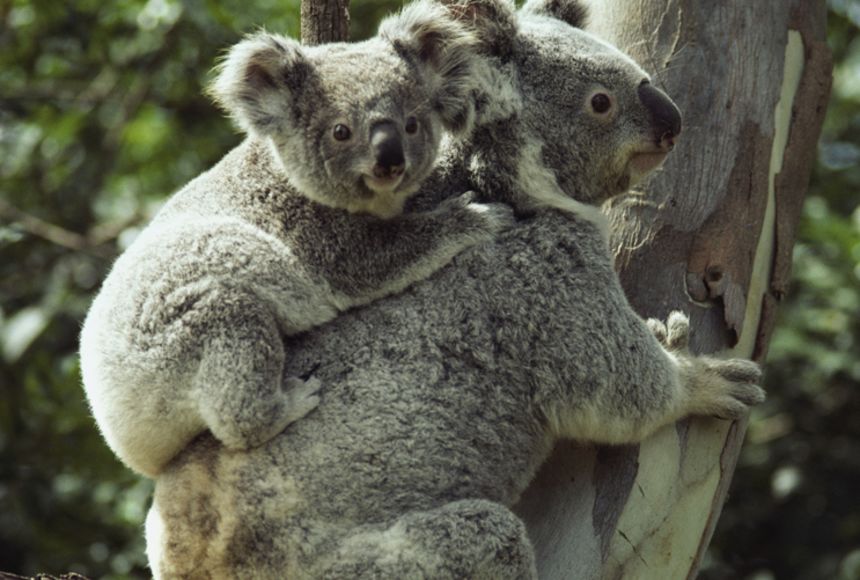
Koalas Climb a Eucalyptus Tree
Picture of a koala with baby koala
Photograph by Anne Keiser

An adaptation is a change that helps an animal. It happens in an organism's genes. Genes are like instructions. They tell living things how to look. They also tell them how to behave. Genes are passed down from parent to child. An adaptation helps an organism survive. Animals have many different adaptations. Adaptations are how new kinds of plants and animals come to be.
Structural and Behavioral Adaptations
Some adaptations are structural. That means they are physical. They are changes in an organism's body. Other adaptations are behavioral. They are changes in how an organism acts.
Many plants have structural adaptations. Succulents are one example. These are plants that live in hot, dry deserts. Succulents have a special adaptation. They can store water in their thick leaves.
There are many examples of behavioral adaptations. Migration is just one. Gray whales (Eschrichtius robustus) migrate every year. They spend some time in warm waters. They spend some time in cold waters. That way, they get the benefits of both.
Habitat
Animals adapt to their environment. They change as the environment changes.
The peppered moth (Biston betularia) is a famous example. Long ago, most peppered moths were light. Only a few were gray or black. Then their environment changed. People began building factories. These created lots of smoke. Dark moths could blend in where there was smoke. White moths could not. The white moths were eaten. Soon, the dark moths became more common.
Speciation
Some adaptations are small. Others are not. A very special adaptation can create a whole new kind of animal. This is known as speciation.
Australia is home to many marsupials. These are a type of mammal. They carry their young in pouches. Marsupials adapted to live in Australia. Over time, they changed. They became new kinds of animals. Each one plays a special part in the environment.
Coadaptation
Organisms do not always adapt alone. Sometimes they adapt with other organisms. This is called coadaptation. Certain flowers have adapted their nectar. They have made it tastier for hummingbirds. Hummingbirds have adapted their beaks. Longer beaks help them collect nectar. This relationship helps both organisms. Hummingbirds pick up pollen while drinking nectar. The flowers get to spread their pollen. The hummingbirds get food.
Credits
Media Credits
The audio, illustrations, photos, and videos are credited beneath the media asset, except for promotional images, which generally link to another page that contains the media credit. The Rights Holder for media is the person or group credited.
Expert Reviewer
Director
Author
Production Managers
Program Specialists
Producer
other
Last Updated
August 3, 2026
User Permissions
For information on user permissions, please read our Terms of Service. If you have questions about how to cite anything on our website in your project or classroom presentation, please contact your teacher. They will best know the preferred format. When you reach out to them, you will need the page title, URL, and the date you accessed the resource.
Media
If a media asset is downloadable, a download button appears in the corner of the media viewer. If no button appears, you cannot download or save the media.
Text
Text on this page is printable and can be used according to our Terms of Service.
Interactives
Any interactives on this page can only be played while you are visiting our website. You cannot download interactives.