ARTICLE
leveledARTICLE
Adaptation and Survival
Adaptation and Survival
An adaptation is any heritable trait that helps an organism, such as a plant or animal, survive and reproduce in its environment.
Grades
5 - 12
Image
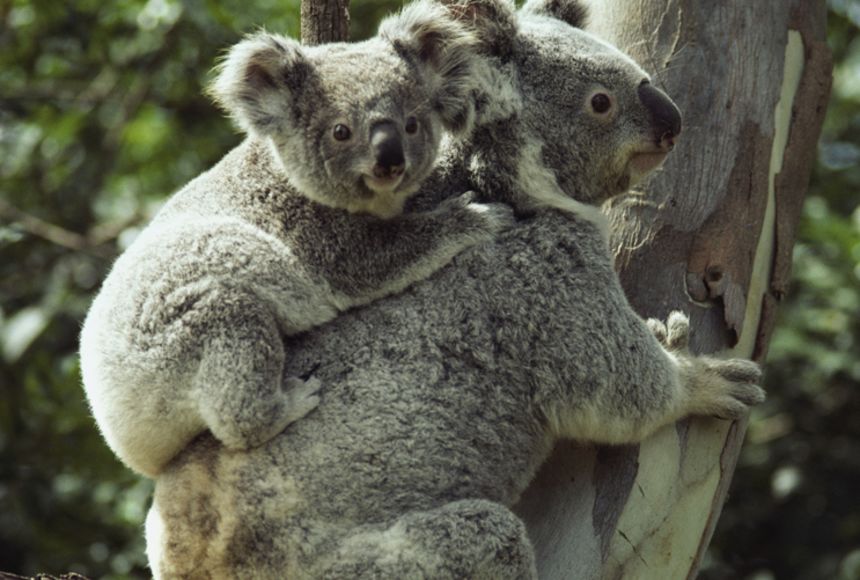
Koalas Climb a Eucalyptus Tree
Picture of a koala with baby koala
Photograph by Anne Keiser

Animals of the same species are not all exactly the same. Differences largely come from an organism's genes. Genes can be thought of as instructions that are passed down from parent to child. They shape how living things look and behave. Some differences help an animal survive and are called adaptations. Adaptations are passed on from one generation to the next. Over time, they spread and become part of the species.
Structural and Behavioral Adaptations
Some adaptations are structural. That means they are a physical part of the organism. Other adaptations are behavioral, affecting the way a living thing acts.
An example of a structural adaptation is the way some plants have adapted to hot, dry deserts. Plants called succulents have found a way to survive there. They do it by storing water in their thick stems and leaves.
Migration is an example of a behavioral adaptation. Gray whales (Eschrichtius robustus) migrate thousands of kilometers every year. They swim from the cold Arctic Ocean to the warm waters off the coast of Mexico. Gray whale calves are born in the warm water. Later, they travel to the Arctic waters to feed.
Some adaptations are called exaptations. An exaptation is an adaptation developed for one purpose but used for another. For example, feathers were probably adaptations for managing temperature. Later, they grew bigger and allowed some species to fly.
Habitat
Adaptations are often a response to a change in the environment.
England's peppered moth (Biston betularia) is a famous example. Before the 1800s, most peppered moths were light with darker spots. Some moths were gray or black. However, these dark moths were rare.
Over time, the rise of factories changed the environment. The darker moths became more common. Their sooty color blended in with the trees stained by pollution. Birds could not see the dark moths, so they ate the light moths instead.
Speciation
Sometimes, an organism develops an adaptation that splits one species into two. This is known as speciation.
One way this can happen is through physical isolation.
A good example is the wide range of marsupials in Oceania. This area includes Australia and New Zealand. Long ago, Oceania was part of Asia. Before it broke away, marsupials arrived. Marsupials are mammals that carry their young in pouches. They are now the main type of mammal in Oceania.
Koalas (Phascolarctos cinereus) are one of the most famous marsupials. They adapted to feed on the eucalyptus trees. These trees grow in Australia. The Tasmanian tiger (Thylacinus cynocephalus) was a meat-eating marsupial. It adapted to fill the role played by big cats, such as tigers, on other continents. These different marsupials are an example of speciation. They developed to fill empty roles in their environment.
Coadaptation
Organisms sometimes adapt with other organisms. This is called coadaptation. Certain flowers have adapted their nectar to appeal to hummingbirds. Hummingbirds have adapted long, thin beaks to drink nectar from certain flowers. This relationship helps both organisms. When a hummingbird drinks nectar, it picks up pollen and spreads it to other flowers. The hummingbird gets food, and the plant's pollen gets distributed.
Mimicry is another type of coadaptation. With mimicry, one organism has adapted to look like another. The harmless king snake is a good example. Over time, it has developed a color pattern that looks like the deadly coral snake. This mimicry keeps predators away from the king snake.
Credits
Media Credits
The audio, illustrations, photos, and videos are credited beneath the media asset, except for promotional images, which generally link to another page that contains the media credit. The Rights Holder for media is the person or group credited.
Expert Reviewer
Director
Author
Production Managers
Program Specialists
Producer
other
Last Updated
August 3, 2026
User Permissions
For information on user permissions, please read our Terms of Service. If you have questions about how to cite anything on our website in your project or classroom presentation, please contact your teacher. They will best know the preferred format. When you reach out to them, you will need the page title, URL, and the date you accessed the resource.
Media
If a media asset is downloadable, a download button appears in the corner of the media viewer. If no button appears, you cannot download or save the media.
Text
Text on this page is printable and can be used according to our Terms of Service.
Interactives
Any interactives on this page can only be played while you are visiting our website. You cannot download interactives.