ARTICLE
ARTICLE
Explorer Profile: Branwen Williams, Environmental Scientist
Explorer Profile: Branwen Williams, Environmental Scientist
Branwen Williams studies the ocean by looking at the growth rings of coralline algae in the Arctic region, which record the ocean’s chemistry.
Grades
5 - 8
Subjects
Biology, Ecology, Conservation, Geography, Physical Geography
Image
Branwen Williams
Branwen Williams studies the skeletal remains of coralline algae to learn about the Arctic’s past climate. From this information, she and her colleagues were able to reconstruct the temperature in the sub-Arctic between 1665 and 2007.
Photograph courtesy of Branwen Williams
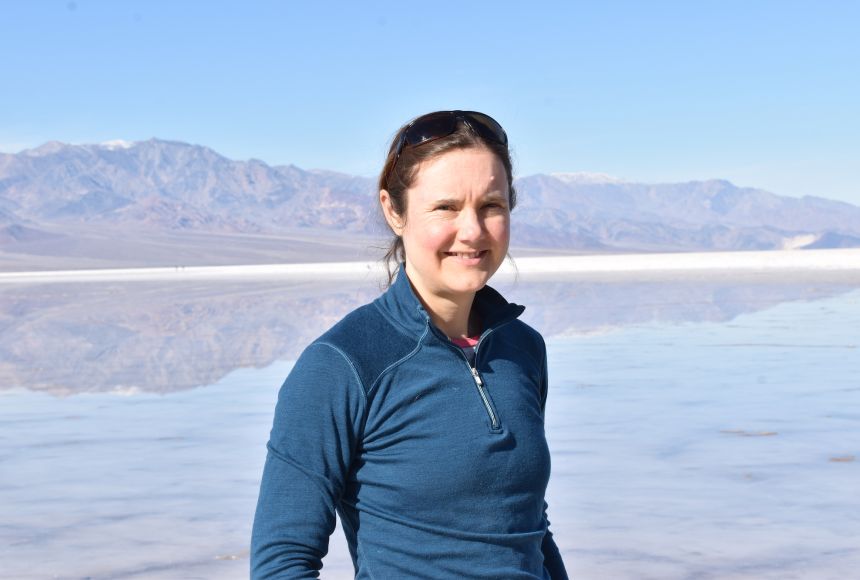
Hopping from one block of ice to another above the Arctic Ocean, environmental scientist and National Geographic Explorer Branwen Williams and her team were on the hunt for coralline algae. This type of marine algae lives on rocks on the seafloor where it very slowly grows a hard skeleton. For scientists like Williams, these skeletons can be read as a historical record of the sea. After finding a suitable spot, Williams helped cut open a hole in the ice. A professional diver then slipped into the nearly freezing water to retrieve a chunk of algae skeleton for the scientists to study.
Williams always loved the sea, so she went to school to learn more about how humans are changing the ocean. She received her undergraduate degree studying marine and freshwater biology and completed a master’s degree in biology as well. Her Ph.D. in the geological sciences at the Ohio State University was focused on understanding the chemistry of the ocean by studying the skeletons of tropical corals.
As a professor at Claremont McKenna, Pitzer, and Scripps Colleges in California, the United States, Williams turned her attention to coralline algae. Like corals, coralline algae use the chemicals that surround them in the seawater to build their skeletons. Also like corals, coralline algae can live for hundreds of years, so their skeletons are a long record of the ocean’s chemistry. One advantage of studying coralline algae is that they can live in the Arctic region where the ocean is warming as much as two times faster than other places. Since their skeletons provide a chemical record of ocean history, Williams hopes that coralline algae can provide insight into what is happening on the front lines of climate change.
Back in her lab in California, Williams used a rock saw to slice through a specimen of coralline algae collected from beneath the Arctic ice. Inside, the skeleton reveals concentric growth layers that looked like those in the trunk of a tree. These skeletons hold much information about the Arctic’s past climate. During a warmer year, less ice forms in the Arctic and more light is able to reach the algae. This allows the algae to grow faster, forming a thicker ring within the skeleton. During a cold year with more ice, less light is available to the algae, causing the ring to be narrower.
To better understand the Arctic region’s temperatures, Williams measured the concentrations of magnesium and calcium, both of which are sensitive to temperature, in the coralline algae’s rings. From this information, she and her colleagues were able to reconstruct the temperature in the sub-Arctic between 1665 and 2007. Their results confirmed temperatures in the North Pacific have increased in the last three centuries.
Looking at the patterns of temperature change over years and decades shows that the temperature has been changing differently in the last hundred years, as humans have been increasingly burning fossil fuels. Williams and her colleagues concluded that these recent climate changes in the Arctic region are a result of human activities.
Williams studies the records that marine creatures leave behind, so that she can understand more about the ways humans are changing the ocean. She focuses on the regional climate in the Arctic in hopes that we might be able to slow down those changes. She says, “The changes that we are seeing in the climate are largely caused by people’s activities. What that means though is that if people are causing these changes in the climate, we can do something about it.”
Credits
Media Credits
The audio, illustrations, photos, and videos are credited beneath the media asset, except for promotional images, which generally link to another page that contains the media credit. The Rights Holder for media is the person or group credited.
Director
Author
Production Managers
Program Specialists
Producer
Intern
other
Last Updated
October 19, 2023
User Permissions
For information on user permissions, please read our Terms of Service. If you have questions about how to cite anything on our website in your project or classroom presentation, please contact your teacher. They will best know the preferred format. When you reach out to them, you will need the page title, URL, and the date you accessed the resource.
Media
If a media asset is downloadable, a download button appears in the corner of the media viewer. If no button appears, you cannot download or save the media.
Text
Text on this page is printable and can be used according to our Terms of Service.
Interactives
Any interactives on this page can only be played while you are visiting our website. You cannot download interactives.