ENCYCLOPEDIC ENTRY
ENCYCLOPEDIC ENTRY
Carbon Sources and Sinks
Carbon Sources and Sinks
Carbon sinks absorb more carbon than they release, while carbon sources release more carbon than they absorb.
Grades
5 - 8
Subjects
Conservation, Earth Science, Climatology
Image
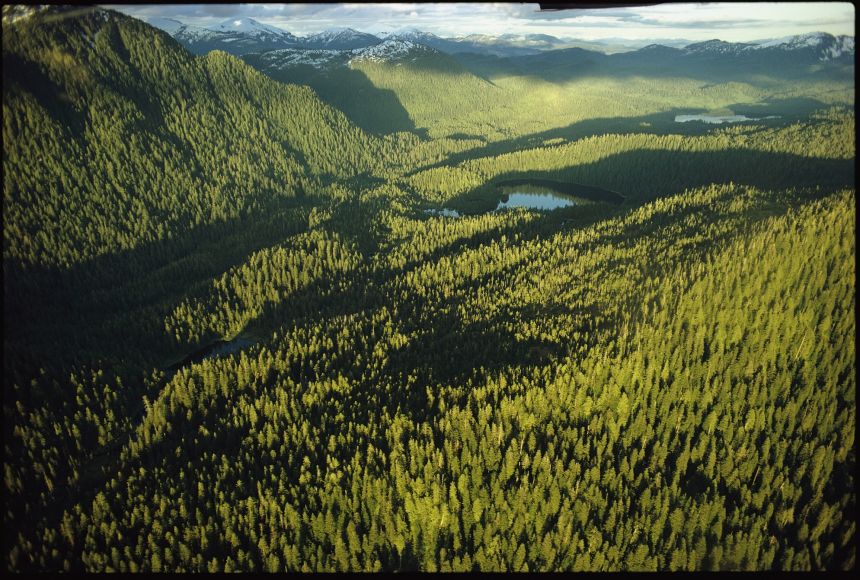
Tongass National Forest Aerial View
With their abundance of plants, forests (like the Tongass National Forest in the U.S. state of Alaska) often absorb more carbon than they release. They continually take carbon out of the atmosphere through the process of photosynthesis.
Photograph by Bruce Dale
Carbon is an element that is essential to all life on Earth. Carbon makes up the fats and carbohydrates of our food and is part of the molecules, like DNA and protein, that make up our bodies. Carbon, in the form of carbon dioxide, is even a part of the air we breathe. It is also stored in places like the ocean, rocks, fossil fuels and plants.
The carbon cycle describes the flow of carbon between each of these places. For example, carbon continually flows in and out of the atmosphere and also living things. As plants photosynthesize, they absorb carbon dioxide from the atmosphere. When plants die, the carbon goes into the soil, and microbes can release the carbon back into the atmosphere through decomposition.
Forests are typically carbon sinks, places that absorb more carbon than they release. They continually take carbon out of the atmosphere through the process of photosynthesis. The ocean is another example of a carbon sink, absorbing a large amount of carbon dioxide from the atmosphere.
Some processes release more carbon dioxide into the atmosphere than they absorb. Any process that uses fossil fuels—such as burning coal to make electricity—releases a lot of carbon into the atmosphere. Raising cattle for food also releases a lot of carbon into the atmosphere. These processes that release carbon into the atmosphere are known as carbon sources.
Ideally, the carbon cycle would keep Earth’s carbon concentrations in balance, moving the carbon from place to place and keeping atmospheric carbon dioxide levels steady. However, the carbon cycle is changing because of human activity. People are releasing more carbon into the atmosphere by using fossil fuels and maintaining large livestock operations. Deforestation is depleting Earth’s supply of carbon sinks. As a result, the amount of carbon in the atmosphere is rising.
Credits
Media Credits
The audio, illustrations, photos, and videos are credited beneath the media asset, except for promotional images, which generally link to another page that contains the media credit. The Rights Holder for media is the person or group credited.
Director
Author
Production Managers
Program Specialists
Producer
Intern
other
Last Updated
January 12, 2026
User Permissions
For information on user permissions, please read our Terms of Service. If you have questions about how to cite anything on our website in your project or classroom presentation, please contact your teacher. They will best know the preferred format. When you reach out to them, you will need the page title, URL, and the date you accessed the resource.
Media
If a media asset is downloadable, a download button appears in the corner of the media viewer. If no button appears, you cannot download or save the media.
Text
Text on this page is printable and can be used according to our Terms of Service.
Interactives
Any interactives on this page can only be played while you are visiting our website. You cannot download interactives.