ENCYCLOPEDIC ENTRY
ENCYCLOPEDIC ENTRY
Carnivores
Carnivores
A carnivore is an organism whose diet consists primarily of meat.
Grades
5 - 8
Subjects
Biology, Ecology, Conservation
Image
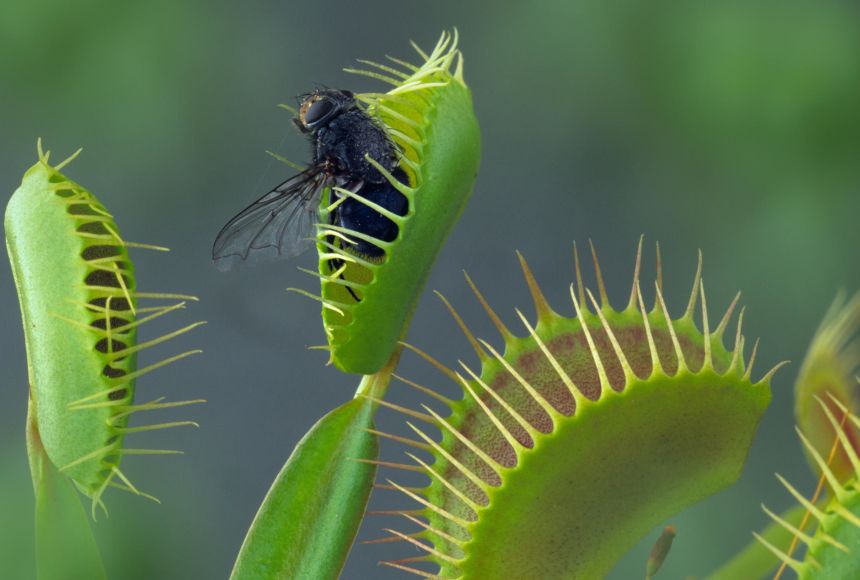
Venus Flytrap Catches Housefly
The Venus flytrap (Dionaea muscipula) is likely the best known of around 600 species of carnivorous plants. Here a housefly (Musca domestica) is caught by a Venus flytrap.
Photograph by Ernie James/Alamy Stock photo
A carnivore is an organism, in most cases an animal, that eats meat. A carnivorous animal that hunts other animals is called a predator; an animal that is hunted is called prey.
An animal’s diet determines where it falls on the food chain, a sequence of organisms that provide energy and nutrients for other organisms. Each food chain consists of several trophic levels, which describe an organism’s role in an ecosystem. Carnivores and omnivores occupy the third trophic level. An omnivore, such as a human, is an organism that eats plants and animals.
Many carnivores get their energy and nutrients by eating herbivores, omnivores, and other carnivores. The animals that eat secondary consumers, like owls that eat rodents, are known as tertiary consumers. Carnivores that have no natural predators are known as apex predators; they occupy the top of the food chain.
Not all carnivores are predators. Some carnivores, known as scavengers, feed on the carcasses of already-dead animals. Vultures, for example, are scavengers.
Carnivores are divided into three different categories based on what percentage of their diet consists of meat. Animals that get 70 percent or more of their nutrition from meat are called obligate carnivores or hypercarnivores. Animals whose diet consists of about 50 percent meat are called mesocarnivores. Animals whose diet is only about 30 percent meat are called hypocarnivores.
Carnivores vary in shape and size, but they often share similar traits. For example, most carnivores have sharp teeth adapted for capturing prey and tearing flesh. Additionally, many carnivores have relatively large brains. Carnivores also have a single stomach chamber and a simple digestive system, unlike herbivores, who often have a stomach with multiple chambers and a specialized digestive system.
Not all carnivores are animals. There are about 600 species of carnivorous plants, the most well-known being the Venus flytrap (Dionaea muscipula). Most carnivorous plants consume insects, but some larger plants feast on small animals, such as frogs or mice.
Carnivores play an important role in keeping ecosystems balanced. Predators keep populations of prey species from becoming too large. Scavengers like vultures help prevent diseases from spreading by eating the remains of dead animals.
Credits
Media Credits
The audio, illustrations, photos, and videos are credited beneath the media asset, except for promotional images, which generally link to another page that contains the media credit. The Rights Holder for media is the person or group credited.
Director
Author
Production Managers
Program Specialists
Producer
Intern
other
Last Updated
October 19, 2023
User Permissions
For information on user permissions, please read our Terms of Service. If you have questions about how to cite anything on our website in your project or classroom presentation, please contact your teacher. They will best know the preferred format. When you reach out to them, you will need the page title, URL, and the date you accessed the resource.
Media
If a media asset is downloadable, a download button appears in the corner of the media viewer. If no button appears, you cannot download or save the media.
Text
Text on this page is printable and can be used according to our Terms of Service.
Interactives
Any interactives on this page can only be played while you are visiting our website. You cannot download interactives.