ARTICLE
leveledARTICLE
Changes in Matter: Physical vs. Chemical Changes
Changes in Matter: Physical vs. Chemical Changes
Physical changes rearrange the structure of a substance, but do not change the molecular structure of what is being changed. Chemical changes result in the change of the molecular structure of what is being changed.
Grades
3 - 12
Image
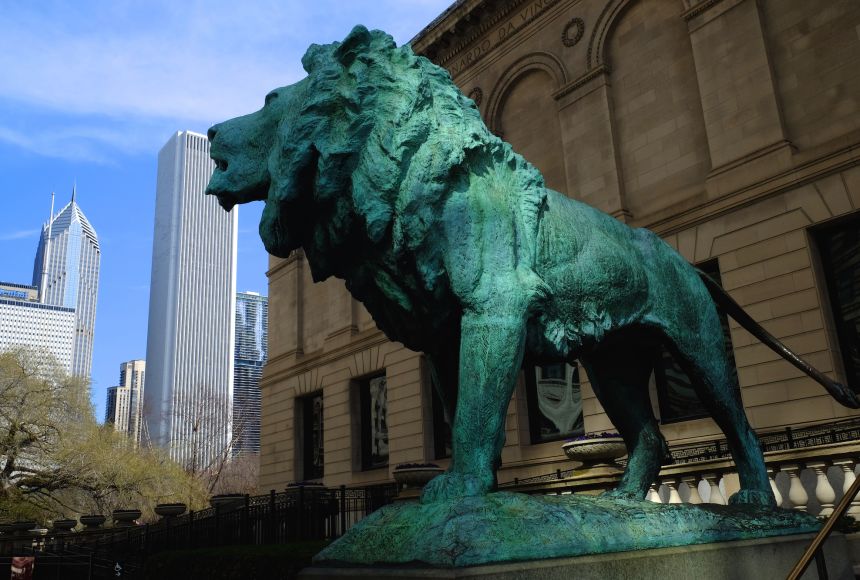
Oxidized Copper Lion
The process of rusting, or oxidization, exemplifies a chemical reaction. Here is an oxidized copper lion statute in front of the Chicago Art Institute and the Aon Center.
Photograph by Paul Damien

Matter is capable of undergoing changes, which are classified as either physical or chemical. Physical changes change the form of a substance, but not its molecular structure, like an ice cube melted into liquid water. While the atoms are moving faster and are farther apart in liquid form, both forms are composed of two atoms of hydrogen and one atom of oxygen or H2O. Chemical changes, on the other hand, alter the molecular structure of a substance by breaking and rearranging the bonds of its atoms. For example, a burning log releases carbon dioxide and water vapor from the cellulose (made of a type of sugar) of the wood and oxygen that fuels the fire. Ash forms from a combination of the minerals, like calcium, within the wood recombining with carbon and oxygen to form calcium carbonate. It is sometimes said that chemical changes cannot be reversed, but that’s not true. Consider the complementary processes of cellular respiration and photosynthesis: C6H12O6 + 6O2 <--> 6CO2 + 6 H2O.
What Is a Physical Change?
In a physical change, the material involved in the change is structurally the same before and after the change. Types of some physical changes are texture, shape, temperature and a change in the state of matter. A change in the texture of a substance is a change in the way it feels. For instance, a block of wood may feel rough when you run your finger across it but rubbing the wood with sandpaper smooths the surface so it no longer feels rough. The wood itself has not changed during sanding to become a new material; only the texture of the surface changed. A piece of metal may be heated in a fire until it glows, but the metal is the same material before heating and after cooling. Similarly, when a material changes phase, it only changes physically; the substance is still the same. Think about ice melting into water, and then water being heated up and turning into steam. The chemical structure of water is the same whether it is a solid (ice), liquid or gas (steam). The atomic structure of the substance remains the same; the difference is in the speed of the atoms, which make up the molecules, move. Gas atoms move faster than liquid atoms, which move faster than solid atoms.
What Is a Chemical Change?
A chemical change occurs when the composition of a substance is changed, which requires the breaking and forming of chemical bonds during a chemical reaction. This results in the rearranging of atoms in substances to form the products of a chemical reaction, which are brand new molecules that cannot be easily reverted back to their original state.
Sometimes it is difficult to tell if a chemical reaction has taken place. To help determine whether there has been a reaction, chemists consider the basic indicators that a reaction has occurred, such as a change in temperature, a change in color, the development of an odor, the formation of a precipitate or the formation of a gas.
In a chemical alteration, the temperature change occurs as a result of the breaking or formation of chemical bonds. When the chemical bonds of the reactants are broken, sometimes excess energy is released, which causes heat to be discharged, and leading to an increase in temperature. Alternatively, a reaction may require energy from the environment in order to take place, causing heat to be absorbed, and leading to a decrease in temperature. Burning wood is an example of a reaction that releases excess energy as heat. A chemical cold pack in a first aid kit is an example of a chemical reaction that absorbs heat energy resulting in cooling.
An example of a color change signaling a chemical reaction can be observed when iron reacts with oxygen to produce iron oxide, such as when an iron nail is left outside, and it develops a reddish-brown rust.
Rotting food is an example of odor development as a result of a chemical change. When food is left out for too long, or it reaches its expiry date, it eventually spoils, often producing a different odor in its rotten state. This is because of chemical reactions that take place as the food begins to break down, which leads to the formation of new substances that have unique smells associated with them.
Another common sign of a chemical reaction is the formation of a precipitate. This happens when chemicals dissolved in a solution are mixed together and an insoluble solid, known as a precipitate, forms in the liquid mixture. The creation of a new, solid substance from two liquid substances indicates that a reaction has taken place and altered the original substances.
A common chemical reaction is the mixing of vinegar and baking soda. When these two household chemicals are mixed together, the mixture immediately starts bubbling and foaming. The bubbles are a release of carbon dioxide gas, a product of the chemical reaction between the baking soda and vinegar.
Chemical Change or Physical Change?
Sometimes it is difficult to determine whether a change is physical or chemical. For example, think about dissolving table salt (sodium chloride) into liquid water. The solid table salt is added to the water and disappears. This dissolution is easily identified as a physical change, because if the water is allowed to evaporate, the salt remains after all the water has evaporated, meaning it has not been permanently altered. However, table salt is an ionic compound. Ions are negatively or positively charged atoms or molecules (because of the loss or gain of an electron). When ionic compounds are added to water, they dissociate or break apart into ions. In the case of table salt, it dissociates into sodium ions (positive) and chloride ions (negative) in the water, which would seem to be a chemical change. However, scientists do not consider this to be a chemical change because the solid table salt remains after the water is evaporated. The table salt dissociated, but the atoms recombine into the same arrangement once the water is removed.
Another example of a change that is difficult to identify as either physical or chemical is when two or more metals are mixed together when molten to form an alloy; an alloy is a metal that has different properties from the metals that were mixed together to make it. A common alloy is brass, which can be found on decorative hinges and knobs, as well as on musical instruments like trumpets, trombones, and saxophones. Brass is made up of about 60% copper and 40% zinc, but brass has different properties than either copper or zinc alone. However, even though the properties of brass are different from copper and zinc, brass is not made via a chemical reaction. The copper and zinc atoms are both in brass, but they do not chemically bond together. As a result, brass represents a physical change instead of a chemical change.
Remember that a physical change is a change in properties such as texture, shape, or state, while a chemical change represents the formation of a new substance after atoms are rearranged in a chemical reaction.
Instructional Links
Credits
Media Credits
The audio, illustrations, photos, and videos are credited beneath the media asset, except for promotional images, which generally link to another page that contains the media credit. The Rights Holder for media is the person or group credited.
Director
Author
Production Managers
Program Specialists
Producer
other
Last Updated
December 1, 2025
User Permissions
For information on user permissions, please read our Terms of Service. If you have questions about how to cite anything on our website in your project or classroom presentation, please contact your teacher. They will best know the preferred format. When you reach out to them, you will need the page title, URL, and the date you accessed the resource.
Media
If a media asset is downloadable, a download button appears in the corner of the media viewer. If no button appears, you cannot download or save the media.
Text
Text on this page is printable and can be used according to our Terms of Service.
Interactives
Any interactives on this page can only be played while you are visiting our website. You cannot download interactives.