ARTICLE
ARTICLE
The Consequences of Mining Pollution in Peru
The Consequences of Mining Pollution in Peru
Extracting natural resources is necessary to maintain a functioning society. However, a balance is necessary to sustain healthy ecosystems and human health.
Grades
8 - 12+
Subjects
Earth Science, Geology, Sociology, Health

Loading ...
Learning materials
Website
Sitting atop Peru’s Central Andes, at about 4,330 meters (14,210 feet) above sea level, Cerro de Pasco is one of the highest cities in the world. Besides its altitude, the city’s most distinguishing feature is a giant pit. At longer than a kilometer (0.6 miles) and more than 450 meters (1,476 feet) deep – enough to bury New York City’s Empire State Building – the pit rips into the landscape like a meteor crash site. But the hole is not the result of a natural disaster: It is a strip mine called El Tajo (officially known as Raúl Rojas).
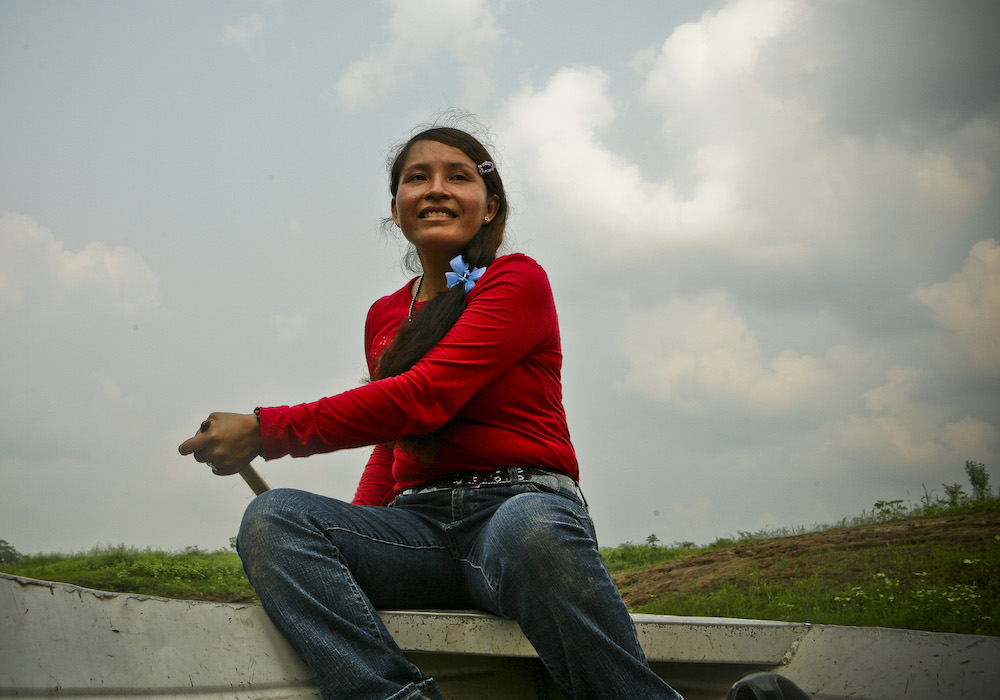
El Tajo has a complicated legacy. The mine has provided jobs for the people of Cerro de Pasco while severely harming the health of those same people, especially children, and causing extensive environmental damage. National Geographic Explorer and photographer Marco Garro created a photographic series documenting the health problems among the families and children of Cerro de Pasco in his photo book “Quiulacocha.”
As an Explorer, Garro’s work is part of the Society’s efforts to inspire people to learn about, care for and protect our world. His photographs focus on children who have grown up with the consequences of mining pollution.
Mining is a form of resource exploitation. This is the withdrawal of natural resources for human use. Overexploitation, which removes resources at an unsustainable level, lessens an ecosystem’s biodiversity, furthers climate change and pollution, worsens health problems in humans and reduces freshwater availability. The children of Cerro de Pasco suffer from daily headaches, stomach pains, vomiting, nose bleeds and cancers. Dangerously high levels of heavy metals, including lead and arsenic, have been found in their blood.
The effects are long lasting. A study, completed in 2023, added even more evidence that lead in the soil from mining is still adversely affecting the community. Nearly 2,000 high school students tested lead amounts in the soil of Cerro de Pasco and two other Peruvian mining towns. The results were geographically consistent with lead levels found in local children’s blood two decades before.
“Indigenous communities throughout the Amazon have been displaced from their traditional territories in order to extract resources like hardwood trees, which are exported and manufactured into paper goods, furniture and other products,” says National Geographic Explorer, writer and oral historian Lyndsie Bourgon. “Clearcut logging also facilitates agriculture, opening up huge swathes of land to grow monocrops including palm oil. All of this extraction has led to increased and widespread forest fires, impacting human health through poor air quality and destroying ecosystems.”
The harm done is not restricted to humans. When the pit was first dug in 1956, it began gutting the surrounding mountains and polluting the waters. Heavy metals, including arsenic, cadmium, manganese and mercury, bleed out from the mountains into Quiulacocha, the local lake. Quiulacocha means lake of gulls in Quechua, but the gulls no longer come to the waters, now orange from mine tailings.
Garro collected water and sediment samples from Quiulacocha. As photographs of the people and the landscape were developed, the samples were then mixed in. It's an artistic statement about what that pollution has done to the environment and the community.
The unsustainable industrial mining at Cerro de Pasco is a modern continuation of historical practices of resource removal, also known as extractivism. “Extractivism takes many forms, including clearcut logging, industrial agriculture, and mining,” Bourgon said. Preindustrial mining in Cerro de Pasco dates back to the Wari Empire around 600 C.E. Cerro de Pasco has been a site of extractivist endeavors since Spanish colonists began to take silver, lead, copper and gold from the mountains four centuries ago.
This history of large-scale resource removal continues in Cerro de Pasco. The Quechua people, who are indigenous to the Andes, have largely been cut off from their ancestral land and have not benefitted equitably from the wealth mining corporations have gained from Cerro de Pasco.
Even though Peru’s economy is largely based on mining, most of the money goes to foreign companies, according to environmental geochemist and National Geographic Explorer Jennifer Angel-Amaya. “The cost is local but the profit is not,” she said, noting most gold refineries are located elsewhere, including the United States, Switzerland and the United Arab Emirates.
And the profits are very high. The price for an ounce of gold was about $5,000 in April 2026, almost six times the cost in April 1996 with inflation.
Angel-Amaya’s work is not focused in Cerro de Pasco, but to the southeast of the country near the border with Brazil and Bolivia, an area called Madre de Dios. The gold mines in that part of Peru present different challenges. That’s where Angel-Amaya works on projects as part of the Perpetual Planet Amazon Expedition to track harmful mining processes and develop solutions in close collaboration with the local communities.
There, in the Amazon basin, prospectors take gold from riverbeds and the soil, which is accessed by burning or cutting down trees. Unlike the larger operations in the highlands, which employ local people, these small, artisanal gold mines use temporary migrant labor from the nearby Andes.
Artisanal gold mining in Madre de Dios was boosted by the 2008 financial crisis, which sent prices soaring because it is favored as a stable commodity in a time of economic uncertainty. These small gold mines flourished with the 2012 completion of the Interoceanic Highway, connecting Atlantic Brazil to the Pacific region of Peru, making the rainforests of Madre de Dios, one of the world’s biodiversity hotspots, more accessible. The region is home to thousands of plant species, more than 850 bird species, more than 1,300 butterfly species and charismatic mammals like Andean bears (Tremarctos ornatus), jaguars (Panthera onca), giant otters (Pteronura brasiliensis) and capybara (Hydrochoerus hydrochaeris).
The region is also home to several Indigenous peoples: Amahuaca, Ese Eja, Harakbut, Matsigenka, Quichua Runa, Shipibo and Yine. Meanwhile, the population of Puerto Maldonado, capital of the region, rose from an official count of 44,000, in 2005, to 85,000 in 2017—with estimates that it may be as high as 141,000. Like other roads, the Interoceanic Highway has led to deforestation, loss of habitat for indigenous species and decrease in biodiversity. The highway was promoted as a way to increase trade, spreading economic opportunities to an economically impoverished area. That success is disputable. That the highway has enabled artisanal gold mines to expand, pushing deeper into the rainforest, is not.
Sometimes these artisanal mines are legal, but most are not. Many are controlled by criminal narcotics-trafficking organizations. Cocaine traffickers are switching to gold because it is now more profitable than illegal drugs, and they are using their smuggling networks to do so, according to Angel-Amaya. Besides sowing environmental damage, these organizations sometimes enslave people to mine for them and sex traffic women and young girls. Traffickers sometimes use violence against journalists, environmentalists and other activists.
Whether legal or illegal, these small mines largely use mercury to extract gold. The mercury binds to the gold, separating it from the rest of the sediment and mixing with water and human hands. And though it’s cheap, fast and easy, mercury is a potentially deadly toxin. Peru's government passed a law that encouraged artisanal gold mining with tax breaks in 1978. Although it has cracked down on illegal mines, the government often overlooks the damage done by mines like those in Cerro de Pasco and the legal mines in Madre de Dios because of the money they make, Angel-Amaya said.
As a geochemist, Angel-Amaya tracks how mercury moves through waterways and watersheds. The Madre de Dios region depends on ecological tourism, therefore the environmental harm mercury is doing directly harms the local economy. The miners “understand that and it’s not like they’re evil,” she said. Willing miners do this dangerous work to support their families. Gold mining pays much more than other available work.
Instead of mercury, Angel-Amaya encourages miners to use ecologically healthier ways to extract gold, including shaker tables, centrifuges and gold-pan kits. These methods use gold’s higher mass to separate it from soil, rock and other substances. Like using mercury, these processes are also simple and inexpensive, but they take much longer and are more labor intensive.
Communities impacted by resource extraction have long been taking action and continue to do so. The community of Cerro de Pasco has participated in protests against the mine’s owner, Volcan, a Peruvian company controlled by foreign investors. Legal action was taken against Volcan’s former Swiss owner, but a vote in the Swiss government failed to reach the threshold necessary to sanction the company.
The high-level citizen science of the 2023 study done by high school students also provides the people of affected communities with the information necessary to decide how they should handle the problem, Angel-Amaya said.
Angel-Amaya is looking at the broader global market to reduce environmental harm from these mines. She is developing portable tools and blockchain systems, the technology used to power cryptocurrency, to source the gold. Blockchain would provide a unique identifier for all gold being sold, thereby certifying mercury-free gold. The incentive would be setting a higher price for gold known not to have been extracted with mercury. There is precedent: Ethically sourced coffee and diamonds are more expensive than undocumented products.
Angel-Amaya and her colleagues are working toward this. They have found initial success in the laboratory using Laser-Induced Breakdown Spectroscopy (LIBS). “The idea is to be able to tell, at the point of sale or export, whether a given batch of alluvial gold from artisanal and small-scale mining (ASGM) was produced with mercury amalgamation or not,” Amaya said. While this methodology provides hope, it hasn’t been tested in the field. Without a successful field test, there can be no custody documentation, certification or market incentives to reward miners for not using mercury.
While the current state of Cerro de Pasco seems bleak, it is also a case study in how communities, including young people, can make a difference. This illustrates the Explorer Mindset in action. The high school students who collected data for the 2023 study are local to the Cerro de Pasco area. With scientists’ help, they took it into their own hands to contribute to educating their community on an issue that directly impacts them. The impacts of resource extraction are far-reaching and multifaceted, and it takes the efforts of specialists like Garro and Angel-Amaya as well as concerned everyday people to make a change.
Credits
Media Credits
The audio, illustrations, photos, and videos are credited beneath the media asset, except for promotional images, which generally link to another page that contains the media credit. The Rights Holder for media is the person or group credited.
Director
Author
Production Manager
Program Specialists
Producer
other
Last Updated
August 18, 2026
User Permissions
For information on user permissions, please read our Terms of Service. If you have questions about how to cite anything on our website in your project or classroom presentation, please contact your teacher. They will best know the preferred format. When you reach out to them, you will need the page title, URL, and the date you accessed the resource.
Media
If a media asset is downloadable, a download button appears in the corner of the media viewer. If no button appears, you cannot download or save the media.
Text
Text on this page is printable and can be used according to our Terms of Service.
Interactives
Any interactives on this page can only be played while you are visiting our website. You cannot download interactives.