ENCYCLOPEDIC ENTRY
ENCYCLOPEDIC ENTRY
Not all Deserts are Sandy
Not all Deserts are Sandy
Deserts are landscapes that receive little precipitation. They can be hot and sandy like the Sahara, or cold and ice-covered like Antarctica.
Grades
5 - 8
Subjects
Earth Science, Climatology, Geography, Physical Geography
Image
The North Pole
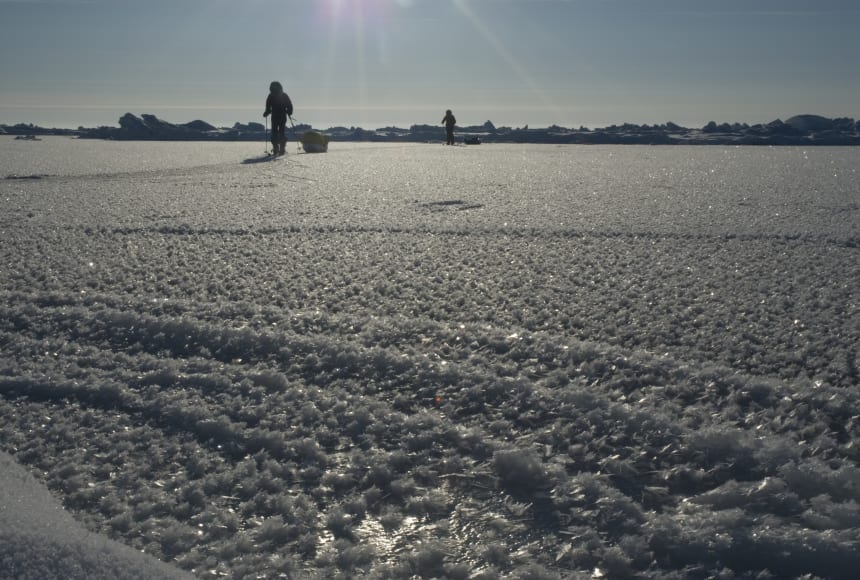
Two North Pole trekkers ski across frozen ocean in the Arctic.
Dan Westergren / National Geographic
Sandy. Dry. Hot. These are the words typically used to describe deserts. But the endless, windswept dunes that come to mind only make up a small percentage of the deserts on the planet. A desert is actually just a place that has very little precipitation.
Subtropical deserts like the Sahara are what people generally imagine when they think about deserts. The Sahara has rocky plateaus as well as sand dunes. During the summer, the temperature in the Sahara can reach over 50°C (122°F), making it one of the hottest deserts on Earth. Despite these temperatures, the Sahara is home to olive trees, antelope, jerboa, scorpions, jackals and hyenas. Some pastoralist or nomadic groups live in the Sahara, such as the Tuareg people of North Africa, or the Teda people of the eastern and central Sahara. Several major cities are located in the Sahara as well, including Egypt’s Cairo, Libya’s Tripoli and Mali’s Timbuktu. At 9.4 million square kilometers (3.6 million square miles), the Sahara is also the largest hot desert on Earth.
The largest desert on Earth is Antarctica, which covers 14.2 million square kilometers (5.5 million square miles). It is also the coldest desert on Earth, even colder than the planet’s other polar desert, the Arctic. Composed of mostly ice flats, Antarctica has reached temperatures as low as -89°C (-128.2°F). The ice that covers the area is on average 3.5 kilometers (1.5 miles) thick. Due to this harsh environment, Antarctica is the least-populated continent on Earth, and the only continent without a native human population. However, multiple countries have set up research stations in Antarctica for the purpose of studying the climate, geology, biology and other subjects, and these stations are staffed by thousands of researchers on long-term stays. There is very little vegetation in Antarctica, so the animals that live there are mostly carnivores, such as penguins, albatrosses, whales and seals. Antarctica’s waters are abundant with sea life, including fish, krill and sea sponges. Another example of a cold desert is the Gobi Desert in northern China and southern Mongolia, in the rain shadow of the Himalayas. The Gobi’s landscape is mostly composed of sedimentary rock, not sand, and there are grassy steppe regions that receive more precipitation.
How can the Sahara, Antarctica and the Gobi all be deserts? The reason is that they all see little precipitation during the course of a year, typically around 25 centimeters (10 inches), or less. This makes them both difficult places for plants and animals to live. All three deserts have fossil evidence suggesting that this was not always true. Based on fossil evidence, the Sahara, Antarctica and the Gobi appear to have been the homes of many plants and animals in the past. In particular, the Mongolian region of the Gobi Desert is rich in fossils from the late Cretaceous period.
Credits
Media Credits
The audio, illustrations, photos, and videos are credited beneath the media asset, except for promotional images, which generally link to another page that contains the media credit. The Rights Holder for media is the person or group credited.
Director
Author
Production Managers
Program Specialists
other
Last Updated
December 2, 2025
User Permissions
For information on user permissions, please read our Terms of Service. If you have questions about how to cite anything on our website in your project or classroom presentation, please contact your teacher. They will best know the preferred format. When you reach out to them, you will need the page title, URL, and the date you accessed the resource.
Media
If a media asset is downloadable, a download button appears in the corner of the media viewer. If no button appears, you cannot download or save the media.
Text
Text on this page is printable and can be used according to our Terms of Service.
Interactives
Any interactives on this page can only be played while you are visiting our website. You cannot download interactives.