ARTICLE
leveledARTICLE
Environmental Impacts of Agricultural Modifications
Environmental Impacts of Agricultural Modifications
With the human population growing, agriculture must keep up the pace. But the innovations that boost crop yields carry ecological costs.
Grades
5 - 12
Subjects
Biology, Ecology, Chemistry, Conservation
Image
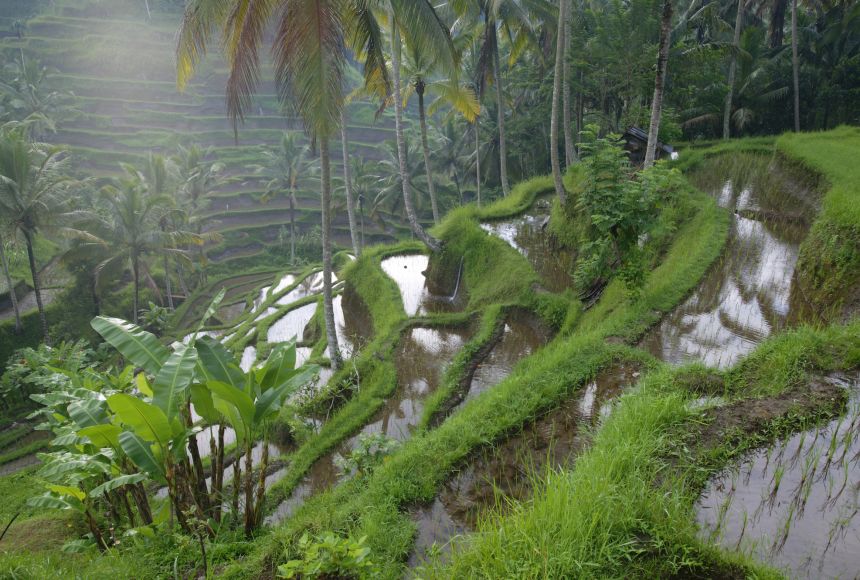
Rice Fields in Bali
More than half the planet's suitable land has been cultivated for crops, like these terraced rice fields in Bali, Indonesia.
Photograph by Cyril Ruoso/NaturePL

Agricultural methods have intensified continuously ever since the Industrial Revolution, and even more so since the “green revolution” in the middle decades of the twentieth century. At each stage, innovations in farming techniques brought about huge increases in crop yields per acre of arable land. This tremendous rise in food production has sustained a global population that has quadrupled in size over the span of one century. As the human population continues to grow, so too has the amount of space dedicated to feeding it. According to World Bank figures, in 2022, more than 730 million hectares (1.8 billion acres) were devoted to growing corn, wheat, rice and other staple cereal grains—nearly half of all cultivated land on the planet.
In the coming decades, however, meeting the demand for accelerated agricultural productivity is likely to be more difficult than it has been so far. Global climate change is destabilizing many of the natural processes that make modern agriculture possible. Yet modern agriculture itself also adds to the crisis of sustainability. Many of the techniques and modifications farmers use to boost output also bring harmful environmental effects. Below are three ways intensive agriculture threatens the precarious balance of non-agricultural ecosystems.
Irrigation
Worldwide, agriculture accounts for 70% of human freshwater consumption. A great deal of this water is redirected onto cropland through irrigation schemes of varying kinds. Experts predict that to keep a growing population fed, water extraction may need to increase by an additional 20% or more by 2050. Irrigation supports the enormous crop yields that such a large population demands. Many of the world’s most productive agricultural regions, from California’s Central Valley to southern Europe’s arid Mediterranean basin, have become economically dependent on heavy irrigation. Irrigation also allows for food to be grown in places it would not otherwise grow, including in deserts.
Researchers and farmers alike are becoming increasingly aware of the consequences of this large-scale diversion of freshwater. One of the most obvious consequences is the depletion of aquifers, river systems and downstream ground water. While irrigation can waste water, most farmers do not intentionally waste or overuse this resource. Water waste can happen when irrigation equipment is out of date or not installed properly, or if there are inadequate cover crops to protect soil conditions. Correcting these issues and improving irrigation technology can be costly. Sociopolitical factors, including challenges with decision making among scientists and stakeholders, can also lead to overuse of water. Additionally, crops that require irrigation are typically in high demand and profitable. For example, cropland for corn and soybeans may increasingly require irrigation due to climate change impacts. Some of these issues can be mitigated with improved education and financial resources for farmers.
There are a number of other environmental consequences related to irrigation. Areas drenched by irrigation can become waterlogged, decreasing oxygen availability in the soil. This can harm plant roots and growth. Waterlogged soils can also accrue too much salt, further harming plant growth. Irrigation causes increases in water evaporation, impacting both surface air temperature and pressure as well as atmospheric moisture conditions. Recent studies have confirmed that cropland irrigation can influence rainfall patterns not only over the irrigated area but dozens to maybe hundreds of kilometers away. Irrigation has also been connected to the erosion of coastlines and other kinds of long-term ecological damage and habitat destruction.
Livestock Grazing
A huge amount of agricultural territory is used primarily as pasture for cattle—cows that humans raise for meat or milk—and other livestock. In many areas, raising cows for meat and dairy is profitable because of the high demand for these products. In some countries, including the United States, raising cows is incentivized through subsidies. In the western United States, counting both federally managed and privately owned grazing lands, hundreds of millions of acres are set aside for this purpose, more than for any other type of land use. Agricultural livestock are responsible for a large proportion of global greenhouse gas emissions, most notably methane. In addition, cows overgrazing pastureland is a major problem regarding environmental sustainability.
In some places, cows and other livestock consume stretches of forage land so extensively that grasses are unable to regenerate. The root systems of native vegetation can be damaged so much that the species die off. Near streambeds or other bodies of water where cattle concentrate, the combination of overgrazing and fecal wastes can contaminate water sources. Cows and other large grazing animals can even damage soil by trampling on it, compacting the soil. Bare, compacted land can bring about soil erosion and destruction of topsoil quality due to the runoff of nutrients. These and other impacts can destabilize a variety of fragile ecosystems and wildlife habitats.
Livestock grazing is a serious threat to the Amazon Rainforest, where land cleared for raising cows accounts for 80% of deforestation. The Amazon is a hub of biodiversity and is home to 10% of known species. Forests also play a significant role in climate regulation. The world relies on the Amazon Rainforest in particular for regulating the global water cycle and storing carbon, but deforestation from agriculture threatens this vital role. People who live in the Amazon Rainforest are directly affected by agricultural practices there, since some of these operations engage in illegal practices, employ harsh working conditions and displace Indigenous people.
One solution to help offset the environmental impacts of overgrazing is to implement rotational grazing. With this method, livestock only graze certain segments of grassland for a period and are moved to a new section before they deplete the grass. While this method has benefits for the environment, it requires additional construction, which comes with additional costs. These costs, in addition to other variables, play a role in how easy it is to implement this method and how willing farmers are to adopt the practice.
Chemical Fertilizer
Synthetic fertilizers containing nitrogen and phosphorus have been at the heart of the intensified farming following the World Wars to the present day. Modern agriculture has become heavily dependent on these chemical inputs, which increased the number of people the world’s farms can feed to about half the world’s population. Synthetic fertilizers are particularly effective in the growing of corn, wheat and rice, and are in large part responsible for the explosive growth of cereal cultivation in recent decades. China, with its rapidly growing population, has become the world’s leading producer of nitrogen fertilizers.
While these chemicals have helped dramatically increase the rate of food production to feed a growing population, they have also helped bring about a gigantic increase of reactive nitrogen levels throughout the environment. The excess levels of nitrogen and phosphorus have caused the once beneficial nutrients to become pollutants. Roughly half the nitrogen in synthetic fertilizers escapes from the fields where it is applied, finding its way into the soil, air, water and rainfall. After soil bacteria convert fertilizer nitrogen into nitrates, rainstorms or irrigation systems carry these toxins into groundwater and river systems. Accumulated nitrogen and phosphorus harm terrestrial and aquatic ecosystems by loading them with too many nutrients, a process known as eutrophication. Nutrient pollution is a causal factor in toxic algae blooms affecting lakes in China, the United States and elsewhere. As excessive amounts of organic matter decompose in aquatic environments, they can bring about oxygen depletion and create “dead zones” within bodies of water where nothing can survive. Parts of the Gulf of Mexico are regularly afflicted in this manner. Nitrogen accumulation in water and on land threatens biodiversity and the health of native plant species and natural habitats. In addition, fertilizer application in soil leads to the formation and release of nitrous oxide, one of the most harmful greenhouse gases.
Agriculture Working in Harmony with the Environment
Agriculture does not need to be destructive to the natural environment. Regenerative agricultural systems use a variety of methods, including no-till farming and planting cover crops, to minimize environmental impacts. These methods also increase the industry’s resilience to climate change by improving soil water retention and promoting healthy ecosystems. Regenerative agricultural systems prioritize the health of ecosystems and communities and support local jobs and economies. Many communities around the world successfully use regenerative agriculture practices, especially Indigenous communities.
Indigenous peoples around the world are stewards of environments when they practice agriculture. They manage at least a quarter of land on the Earth’s surface, yet protect much of the world’s biodiversity. Although many Indigenous people have struggled to maintain their ancestral ways of practicing agriculture due to the impacts of colonization—such as European colonizers forcing Indigenous peoples from their lands and exploiting the environment—recent years have brought a renewed interest in reviving these practices, including polyculture.
Many large-scale agricultural systems in place today rely on monoculture, or planting a single crop. In contrast, many forms of Indigenous agriculture use polyculture, where multiple species are cultivated at once, mimicking how an ecosystem supports many types of species. Sometimes this is referred to as agrobiodiversity because of its improvements to biodiversity. These systems use resources more effectively because the crops grown together do not compete for nutrients in the soil and can produce higher yields. These systems are also better adapted to climate change because they provide a more stable source of food in the face of variable climate conditions.
In Northeast India, rural Indigenous people use a form of polyculture known as the bari system to provide food for their households. Individual crops grown in an area called a bari vary, but the system is defined by the diversity of crops and livestock. A bari often includes a pond where households raise fish. It can also include cows and other livestock. People grow fruits and vegetables where the soil is enriched by organic waste from both the farm animals and household. Importantly, the maintenance of a bari also includes thoughtful harvesting. For example, fish are not harvested during the monsoon season because that is when the fish breed.
The loss of pollinators threatens numerous species, including humans, as well as the agricultural system itself. Globally, over 75% of global crop production depends on pollinators. Yet, current agricultural practices threaten pollinators, including native bees, bats and butterflies, by polluting and removing their habitats. In sub-Saharan Africa, agricultural land use threatens pollinators, despite the fact that pollinators add tremendous value to the agriculture industry. In Rwanda alone, it is estimated that saving pollinators could generate an additional $100 million in crop value. To improve pollinator populations, some governments and organizations are encouraging farmers in the region to grow pollinator-friendly plants by providing them with seeds for these plants as well as resources and training programs. For example, as part of a global coalition to protect pollinators, Nigeria has been creating a training program for beekeeping.
Improving the dominant agricultural system also means addressing the inequities it has created, which go hand-in-hand with ecological impacts. The current industrialized agricultural model has removed land from many marginalized communities and consolidated them into the hands of wealthy landowners. For example, in the 20th century, Black farmers in the United States lost millions of acres of land through a variety of racist policies and other barriers, including violence. The effects of these and similar actions can still be seen today, because 98% of farmland in the United States is owned by white farmers.
While agriculture’s impact on the environment is a systemic issue, there are individual actions that can help mitigate the impact. This includes reducing food waste and making thoughtful dietary changes, including choosing to buy from farms that practice regenerative agriculture or eating a plant-based diet, which contributes less to greenhouse gas emissions than a meat-heavy diet. Additionally, some sources of protein contribute less to greenhouse gas emissions than others. Per kilogram, farming oysters emits a fraction of the greenhouse gases that producing beef from cows does. Individuals can also help make a change by participating in movements like Meatless Monday to encourage larger change.
There are many large-scale efforts across the world working to address the various intersections between the environment and agriculture. For example, the United Nations Food and Agriculture Organization (FAO) leads many coordinated efforts to make agriculture more environmentally sustainable while also supporting nutrition and livelihoods. Additionally, the Intergovernmental Panel on Climate Change (IPCC) works with governments to study the connections between climate change and agriculture. The Intergovernmental Science-Policy Platform on Biodiversity and Ecosystem Services (IPBES) provides assessments and policy recommendations specifically on impacts to biodiversity.
With the global population continuing to skyrocket, humanity may soon find itself on a collision course needed to balance agricultural growth and the ecological health of the land upon which humans depend will only intensify.
Articles & Profiles
Credits
Media Credits
The audio, illustrations, photos, and videos are credited beneath the media asset, except for promotional images, which generally link to another page that contains the media credit. The Rights Holder for media is the person or group credited.
Director
Author
Production Managers
Program Specialists
Producer
other
Last Updated
February 4, 2026
User Permissions
For information on user permissions, please read our Terms of Service. If you have questions about how to cite anything on our website in your project or classroom presentation, please contact your teacher. They will best know the preferred format. When you reach out to them, you will need the page title, URL, and the date you accessed the resource.
Media
If a media asset is downloadable, a download button appears in the corner of the media viewer. If no button appears, you cannot download or save the media.
Text
Text on this page is printable and can be used according to our Terms of Service.
Interactives
Any interactives on this page can only be played while you are visiting our website. You cannot download interactives.