ENCYCLOPEDIC ENTRY
ENCYCLOPEDIC ENTRY
Forest Biome
Forest Biome
Forests support a huge diversity of life. Despite the importance of forests, they are being removed at frightening rates.
Grades
5 - 8
Subjects
Biology, Ecology, Geography, Physical Geography
Image
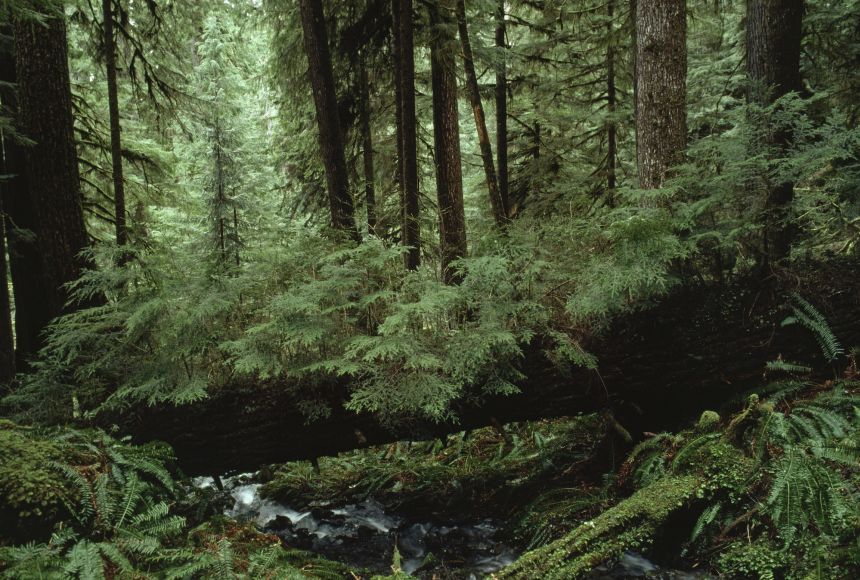
Hoh River Valley
A fallen log spans a stream in a lush green forest in the Pacific Northwest.
Sam Abell
The word forest broadly describes an area that has a large number of trees. There are three general types of forest that exist: temperate, tropical and boreal. Experts estimate that these forests cover approximately one-third of Earth’s surface.
Temperate forests are found across eastern North America and Eurasia. The temperatures of temperate forests vary throughout the year because of the four distinct seasons at these latitudes. Precipitation is abundant and lends to fertile soil that is able to support diverse flora like maples, oak and birch. Deer, squirrels and bears are just a few examples of the fauna that call temperate forests home.
Tropical forests are common to areas near the equator, such as Southeast Asia, sub-Saharan Africa, and Central America. Temperatures in tropical forests have been reported to range between 20° and 31°C (68° and 88°F). Tropical rainforests are the epitome of biodiversity. Animals include the endangered harpy eagle (Harpia harpyja)—a large predatory bird—which has become scarce throughout Central and South America, largely due to habitat loss.
Bonobos (Pan paniscus), an ape species that calls the tropical forests of the Democratic Republic of the Congo in Africa their home, are also endangered. Their populations have suffered because of ongoing civil and regional military conflicts from 1996 to at least the end of 2025, which have resulted in six-million human deaths. This conflict has stripped people of jobs and resources. As a result, some people have deforested bonobo territory for agriculture, poached bonobos for profit and sustenance or accidentally killed in fighting, all of which have caused their populations to decline.
Tropical mangrove forests, characterized by trees and shrubs that grow in salty or brackish water, are found in the tropics and subtropics. The red mangrove forest on the Panamanian island of Escudo de Veragua is home to the critically endangered pygmy three-toed sloth (Bradypus pygmaeus).
The third type of forest is the boreal forest, also known as taiga. Boreal forests, one of the world’s largest land biomes, are found across Siberia, Scandinavia and North America (Alaska and Canada). Boreal forests have a significant role in removing carbon dioxide from the atmosphere. Temperatures in boreal forests are, on average, below freezing. Conifers, spruce, fir and pine trees are the predominant needle-leaf plant species in boreal forests. Moose and deer are just a couple of examples of large herbivorous mammals in this environment. Most birds native to the taiga migrate to find warmer conditions during the forest’s harsh winters.
Credits
Media Credits
The audio, illustrations, photos, and videos are credited beneath the media asset, except for promotional images, which generally link to another page that contains the media credit. The Rights Holder for media is the person or group credited.
Director
Author
Production Managers
Program Specialists
other
Last Updated
January 21, 2026
User Permissions
For information on user permissions, please read our Terms of Service. If you have questions about how to cite anything on our website in your project or classroom presentation, please contact your teacher. They will best know the preferred format. When you reach out to them, you will need the page title, URL, and the date you accessed the resource.
Media
If a media asset is downloadable, a download button appears in the corner of the media viewer. If no button appears, you cannot download or save the media.
Text
Text on this page is printable and can be used according to our Terms of Service.
Interactives
Any interactives on this page can only be played while you are visiting our website. You cannot download interactives.