ENCYCLOPEDIC ENTRY
ENCYCLOPEDIC ENTRY
The Great Wall of China
The Great Wall of China
The Great Wall of China was built over centuries by China’s emperors to protect their territory. Today, it stretches for thousands of miles along China’s historic northern border.
Grades
5 - 8
Subjects
Anthropology, Geography, Human Geography, Social Studies, Ancient Civilizations, World History
Image
The Great Wall of China
The Great Wall of China is one of the most notorious structures in the entire world. The Jinshanling section in Hebei Province, China, pictured here, is only a small part of the wall that stretches over 4,000 kilometers (2,500 miles).
Photograph by Hung Chung Chih
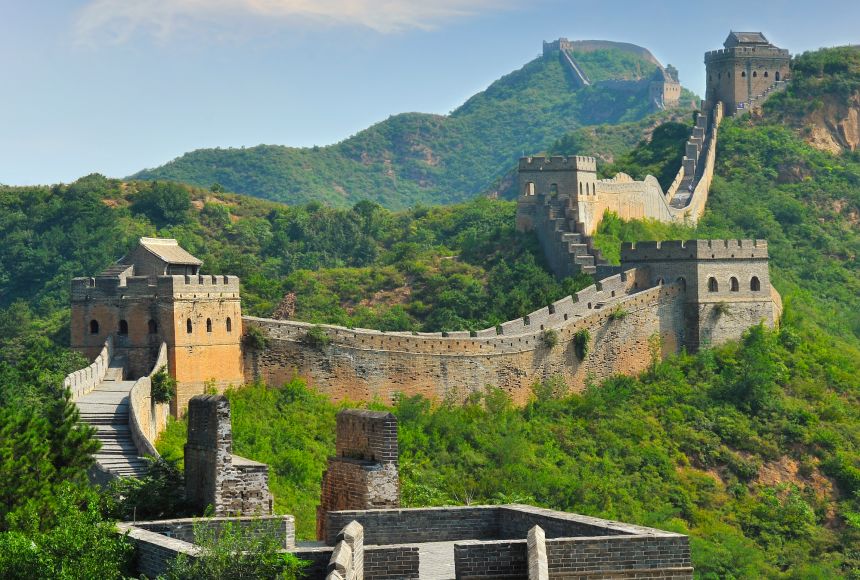
The one thing most people “know” about the Great Wall of China—that it is one of the only man-made structures visible from space—is not actually true. Since the wall looks a lot like the stone and soil that surround it, it is difficult to discern with the human eye even from low Earth orbit, and is difficult to make out in most orbital photos. However, this does not detract from the wonder of this astounding ancient structure.
For millennia, Chinese leaders instituted wall-building projects to protect the land from northern, nomadic invaders. One surviving section of such an ancient wall, in the Shandong province, is made of hard-packed soil called “rammed earth” and is estimated to be 2,500 years old. For centuries during the Warring States Period, before China was unified into one nation, such walls defended the borders.
Around 220 B.C.E., Qin Shi Huang, also called the First Emperor, united China. He masterminded the process of uniting the existing walls into one. At that time, rammed earth and wood made up most of the wall. Emperor after emperor strengthened and extended the wall, often with the aim of keeping out the northern invaders. In some places, the wall was constructed of brick. Elsewhere, quarried granite or even marble blocks were used. The wall was continuously brought up to date as building techniques advanced.
Zhu Yuanzhang, who became the Hongwu Emperor, took power in 1368 C.E. He founded the Ming Dynasty, famous for its achievements in the arts of ceramics and painting. The Ming emperors improved the wall with watchtowers and platforms. Most of the familiar images of the wall show Ming-era construction in the stone. Depending on how the wall is measured, it stretches somewhere between 4,000 and 5,500 kilometers (2,500 and 3,400 miles).
In the 17th century, the Manchu emperors extended Chinese rule into Inner Mongolia, making the wall less important as a defense. However, it has retained its importance as a symbol of Chinese identity and culture. Countless visitors view the wall every year. It may not be clearly visible from space, but it is considered “an absolute masterpiece” here on Earth.
Credits
Media Credits
The audio, illustrations, photos, and videos are credited beneath the media asset, except for promotional images, which generally link to another page that contains the media credit. The Rights Holder for media is the person or group credited.
Director
Author
Production Manager
Program Specialists
Specialist, Content Production
Producer
other
Last Updated
October 19, 2023
User Permissions
For information on user permissions, please read our Terms of Service. If you have questions about how to cite anything on our website in your project or classroom presentation, please contact your teacher. They will best know the preferred format. When you reach out to them, you will need the page title, URL, and the date you accessed the resource.
Media
If a media asset is downloadable, a download button appears in the corner of the media viewer. If no button appears, you cannot download or save the media.
Text
Text on this page is printable and can be used according to our Terms of Service.
Interactives
Any interactives on this page can only be played while you are visiting our website. You cannot download interactives.