ENCYCLOPEDIC ENTRY
ENCYCLOPEDIC ENTRY
Groundwater
Groundwater
Groundwater is water that has infiltrated the ground to fill the spaces between sediments and cracks in rock. Groundwater is fed by precipitation and can resurface to replenish streams, rivers, and lakes.
Grades
5 - 8
Subjects
Biology, Ecology, Chemistry, Earth Science
Image
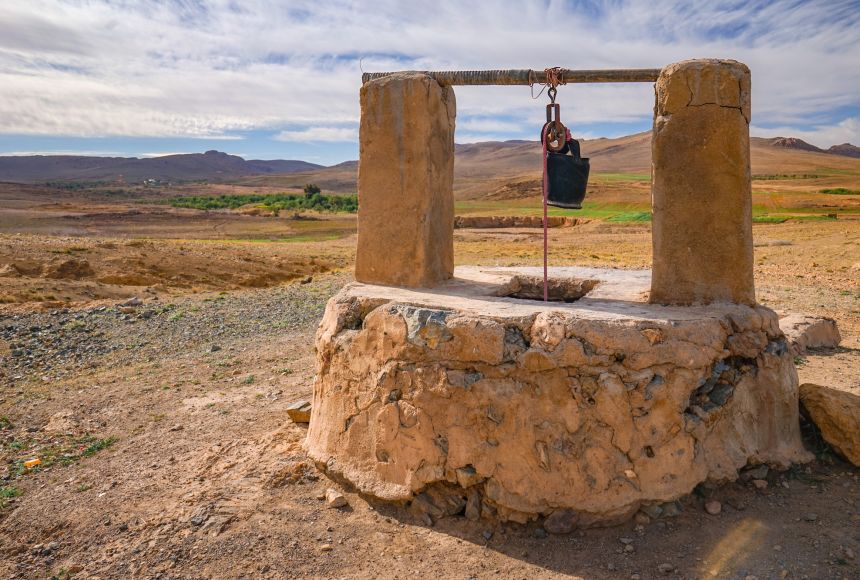
Well
An old well located in the Moroccan desert. Groundwater has been an extremely important source of water for many years, especially in arid climates.
Photograph by Tatsiana Volskaya
Water that has travelled down from the soil surface and collected in the spaces between sediments and the cracks within rock is called groundwater. Groundwater fills in all the empty spaces underground, in what is called the saturated zone, until it reaches an impenetrable layer of rock. Groundwater is contained and flows through bodies of rock and sediment called aquifers. The amount of time that groundwater remains in aquifers is called its residence time, which can vary widely, from a few days or weeks to 10 thousand years or more.
The top of the saturated zone is called the water table, and sitting above the water table is the unsaturated zone, where the spaces in between rocks and sediments are filled with both water and air. Water found in this zone is called soil moisture, and is distinct from groundwater.
Existing groundwater can be discharged through springs, lakes, rivers, streams, or manmade wells. It is recharged by precipitation, snowmelt, or water seepage from other sources, including irrigation and leaks from water supply systems.
To artificially discharge groundwater, a well must be drilled into an aquifer, and a well typically requires a pump to move water upward out of the aquifer. Artesian wells are drilled into aquifers that are bounded by an impenetrable rock layer from both above and below and water pressure from a recharging source located above the well outlet point will cause groundwater to be pushed upward through the artesian well, making the use of a pump unnecessary.
One important reason why groundwater is extracted through wells is to provide drinking water. In fact, groundwater provides drinking water for over 50 percent of the U.S. population, including almost 100 percent of the rural U.S. population. It is also used for domestic, industrial, and commercial purposes, though most groundwater is actually used for irrigation of farmland.
We must take care, however, we do not pump out too much groundwater at once. This can cause wells to dry up if water inputs from recharging cannot keep up with our rate of groundwater removal. This has already happened in East Porterville, California, where an extended drought has led people to drill deeper wells, which has resulted in decreased groundwater levels and caused wells to further dry up. Another threat to groundwater is pollution by fertilizers, pesticides, and waste from septic tanks, all of which can seep down into aquifers from the soil surface.
Groundwater is everywhere beneath the soil surface and can be ever-present in many places if allowed to recharge. Even in dry conditions, it maintains the flow of rivers and streams by replenishing them, providing a valuable substitute for precipitation.
Credits
Media Credits
The audio, illustrations, photos, and videos are credited beneath the media asset, except for promotional images, which generally link to another page that contains the media credit. The Rights Holder for media is the person or group credited.
Director
Author
Production Managers
Program Specialists
Specialist, Content Production
Producer
other
Last Updated
October 19, 2023
User Permissions
For information on user permissions, please read our Terms of Service. If you have questions about how to cite anything on our website in your project or classroom presentation, please contact your teacher. They will best know the preferred format. When you reach out to them, you will need the page title, URL, and the date you accessed the resource.
Media
If a media asset is downloadable, a download button appears in the corner of the media viewer. If no button appears, you cannot download or save the media.
Text
Text on this page is printable and can be used according to our Terms of Service.
Interactives
Any interactives on this page can only be played while you are visiting our website. You cannot download interactives.