ARTICLE
leveledARTICLE
How an Asexual Lizard Procreates Alone
How an Asexual Lizard Procreates Alone
All moms and no dads, the whiptail still comes up with genetically diverse offspring.
Grades
3 - 12
Subjects
Biology, Genetics
Image
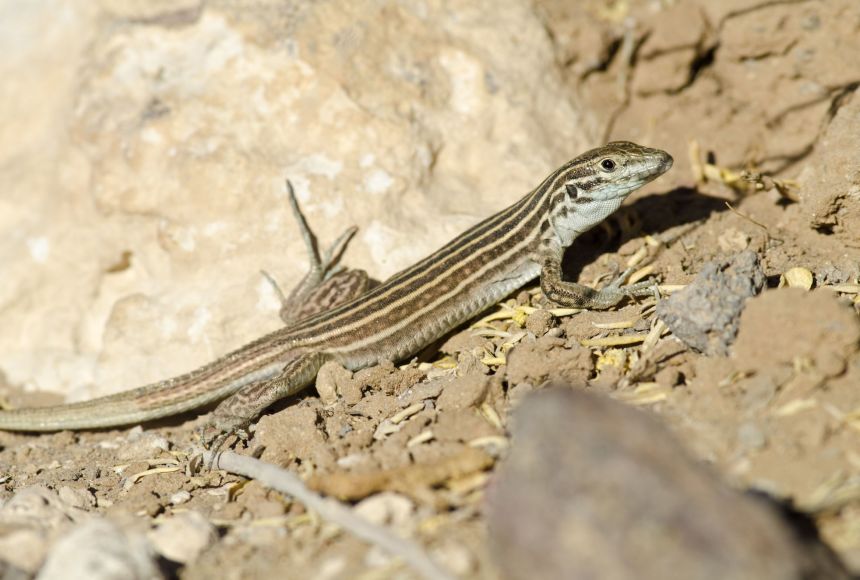
N. Mexico Whiptail Lizard
Without females, lizards in the Aspidoscelis genus, like this New Mexico Whiptail (Aspidoscelis neomexicana), reproduce asexually. Unlike other animals that produce this way, however, their DNA changes from generation to generation.
Photograph by Bill Gorum/Alamy Stock Photo
Sexual reproduction is the way most life-forms procreate, or produce offspring. Each parent provides half an offspring's chromosomes. Over generations, this procreating shuffles the DNA cards, giving sexual reproducers genetic diversity. It is believed that this range of variation in genes can help organisms adapt more successfully to changing environments.
By contrast, asexual reproduction happens in some 70 vertebrate species—species with backbones—and in many less-complex organisms. Asexual species use "all the chromosomes they have" to solitarily produce offspring that are genetic clones, molecular biologist Peter Baumann says. The organisms are genetically identical. Because of that, they're more vulnerable: A disease or an environmental shift that kills one could kill all.
A Full Chromosome Count
But there's a twist in the case of the genus Aspidoscelis, the asexually reproducing whiptail lizard. Baumann and his colleagues have been studying this species at the United States' Stowers Institute for Medical Research in Kansas City, Missouri. The lizards are all female and parthenogenetic, meaning their eggs develop into embryos without fertilization.
But Baumann's team discovered something curious about the whiptail. Before the eggs form, the females' cells gain twice the usual number of chromosomes during meiosis (a stage of cell division during reproduction). This means that the eggs get a full chromosome count—a standard pair of chromosones derived from two sets of pairs. It also means they get genetic variety and breadth (known as heterozygosity) rivaling that of those from sexually reproducing lizards.
Baumann believes he knows why this occurs. At some time in the past, lizards of the genus Aspidoscelis had "a hybridization event," he explains. Females of one species broke form and mated with males of another species. This gave whiptails robust heterozygosity, which has been preserved by the identical replication—essentially, cloning—that occurs in asexual reproduction. It's a genetic-diversity advantage that today's Aspidoscelis females still enjoy and replicate.
Credits
Media Credits
The audio, illustrations, photos, and videos are credited beneath the media asset, except for promotional images, which generally link to another page that contains the media credit. The Rights Holder for media is the person or group credited.
other
Last Updated
November 15, 2024
User Permissions
For information on user permissions, please read our Terms of Service. If you have questions about how to cite anything on our website in your project or classroom presentation, please contact your teacher. They will best know the preferred format. When you reach out to them, you will need the page title, URL, and the date you accessed the resource.
Media
If a media asset is downloadable, a download button appears in the corner of the media viewer. If no button appears, you cannot download or save the media.
Text
Text on this page is printable and can be used according to our Terms of Service.
Interactives
Any interactives on this page can only be played while you are visiting our website. You cannot download interactives.