ENCYCLOPEDIC ENTRY
ENCYCLOPEDIC ENTRY
Landfills
Landfills
Landfills are sites designed to store garbage. They are designed to minimize the effects of the trash on human health and the environment
Grades
5 - 8
Subjects
Biology, Ecology, Conservation, Earth Science
Image
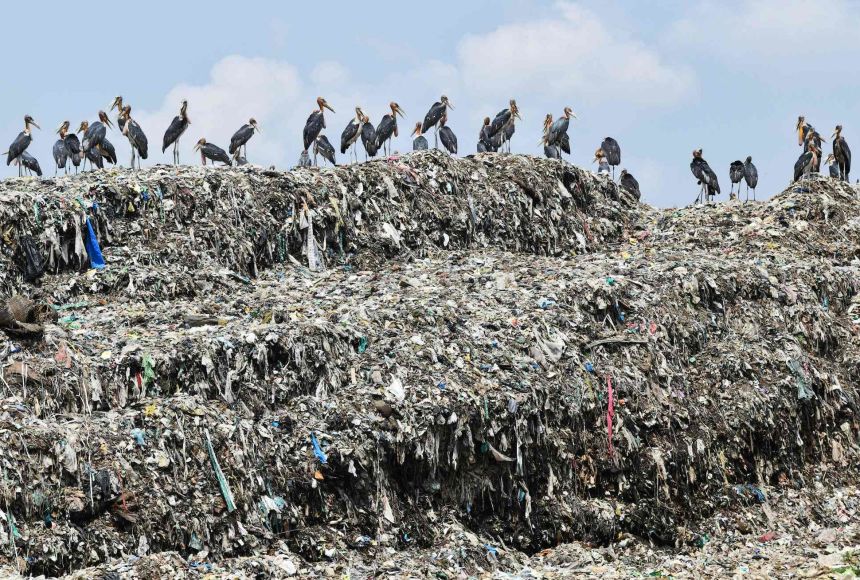
Landfill Storks
Storks sitting on top of a landfill in Guwahati
Photograph by BIJU BORO/AFP via Getty Images
Have you ever wondered where your trash ends up after it’s picked up by a garbage truck? Household garbage, which is also called municipal solid waste, is not just piled up! Garbage trucks take our trash to a municipal solid waste landfill, a site designed to contain household trash. It has specialized structures to reduce the contamination of the surrounding soil or water.
Modern landfills are completely sealed to reduce contamination of the nearby groundwater. First, the ground is lined with clay. A thin layer of flexible plastic is placed on top of the clay layer. That allows the collection of leachate, the liquid that passes through the landfill and may draw out toxins from the trash. The leachate is collected though a drainage system that passes this contaminated water through pipes to a pool where it can be treated to remove the toxins before being released back into the environment.
As trash is laid down into the growing pile, it is compacted into a tightly packed mound. Each day a layer of soil is hauled into cover the garbage to prevent odors and rodent problems. Therefore, the landfill is mostly made up of compressed layers of trash and soil.
A completed landfill is sealed with another layer of clay and thin plastic. Then it is covered with several feet of dirt so that plants can grow on top. Although landfills are designed simply to contain the trash, some of it will decompose over time. The decomposition process produces methane, a dangerous and flammable gas. In modern landfills, the methane is collected in pipes so that it can be vented, burned, or even used as an energy source.
Although modern landfills are designed to keep toxic trash contained, leaks do happen. Therefore, landfills are still dangerous to the environment and human health. The methane that is released due to the decomposing waste is a potent greenhouse gas that contributes to global climate change. The air pollutants escaping from the landfill can also cause respiratory problems in people who live close to the landfill. And if the leachate leaks from landfills, it can bring toxins from the landfill into nearby groundwater supplies. Studies have shown that landfills are more often constructed near low-income neighborhoods and communities of color. Due to this injustice, these people are more likely to experience the health risks associated with landfills.
The damages caused by landfills can be decreased by simply reducing our reliance on landfills. Recycling and composting reduce the amount of waste that has to be transported to landfills.
Credits
Media Credits
The audio, illustrations, photos, and videos are credited beneath the media asset, except for promotional images, which generally link to another page that contains the media credit. The Rights Holder for media is the person or group credited.
Director
Author
Production Manager
Program Specialists
Specialist, Content Production
Producer
other
Last Updated
April 23, 2025
User Permissions
For information on user permissions, please read our Terms of Service. If you have questions about how to cite anything on our website in your project or classroom presentation, please contact your teacher. They will best know the preferred format. When you reach out to them, you will need the page title, URL, and the date you accessed the resource.
Media
If a media asset is downloadable, a download button appears in the corner of the media viewer. If no button appears, you cannot download or save the media.
Text
Text on this page is printable and can be used according to our Terms of Service.
Interactives
Any interactives on this page can only be played while you are visiting our website. You cannot download interactives.