ARTICLE
leveledARTICLE
Marine Food Chain
Marine Food Chain
The marine ecosystem is made up of a complicated series interconnected energy producers—like plants and photoplankton—and consumers—from plant-eaters to meat-eaters, both great and small.
Grades
3 - 12
Subjects
Biology, Ecology
Image
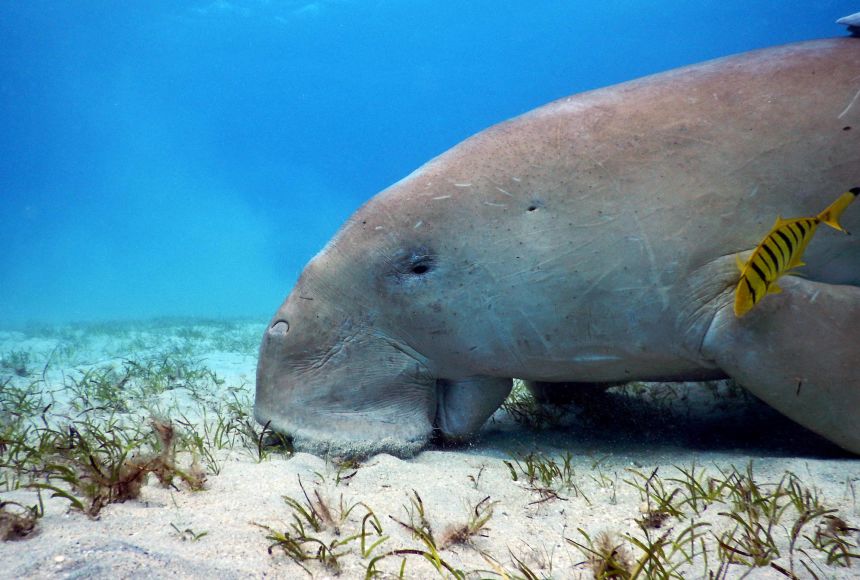
Dugong Feeding on Seagrass
As herbivores, dugong and their manatee cousins occupy the second level of the marine food chain. Here, a dugong feeds on seagrass in the Red Sea.
Photograph by Adam Suto

There are around 300,000 known marine, or ocean, species. A species is a particular kind of plant or animal. Together, these different species make up about 15 percent of the planet's plants and animals.
Most marine species are tied together through the food web. A food web is a system of interconnected food chains. A food chain is a top-to-bottom set of animals and plants. They are linked to each other because those on top eat those below.
Level One: Photoautotrophs
The bottom level of the ocean's food chain is made up of one-celled organisms called phytoplankton. These tiny organisms are microscopic. They are so small they cannot be seen without a microscope.
Billions of phytoplankton live in the upper part of the ocean. They take in the sun's light. Through photosynthesis, they turn the sun's light energy into chemical energy. This chemical energy allows them to survive and grow.
Together, these tiny organisms play a large role. They are the main producers of the carbon all ocean animals need to survive. They also produce more than half of the oxygen we breathe on Earth.
Level Two: Herbivores
The next level of the marine food chain is made up of plant-eaters, or herbivores. Many are microscopic animals known as zooplankton. They drift across the ocean's surface. As they drift, they graze on whatever plants they come across.
Many herbivores are big enough for us to see. They come in a huge range of sizes, though. There are smaller ones, such as surgeonfish and parrotfish, and bigger ones, like green turtles and manatees.
Together, herbivores eat up a huge amount of plant life. However, many of them are eaten in turn. They become food for the carnivorous, or flesh-eating, animals. Carnivores make up the food chain's top two levels.
Level Three: Carnivores
The third level of the food chain consists of a large group of small carnivores. It includes fish, like sardines, herring and menhaden. Such smaller fish eat a great amount of zooplankton. However, they themselves are often eaten.
There is one simple fact of ocean life. Big fish eat smaller fish.
Level Four: Top Predators
Large predators sit at the top of the marine food chain. They are a varied group. Some are finned animals, such as sharks, tuna, and dolphins. Others are feathered animals, like pelicans and penguins. Yet others are animals with flippers, like seals and walruses.
Most top predators are large, fast and very good hunters. They also have longer lifespans. Usually, they reproduce slowly. Females of these species do not give birth that often.
Many of the marine food chain's top predators are eaten too. They are hunted by humans, the most deadly of all hunters. Overfishing by humans can greatly shrink top predator populations. Because such animals reproduce slowly, it can take years for their populations to recover.
The loss of top predator species can create serious problems. These problems ripple through the entire food web. For example, populations of smaller animals that top predators normally feed on can become too large. These smaller animals might then nearly wipe out populations of even smaller animals. Or, they might eat too much plant life. Then, animals that live on plants no longer have enough food.
Alternative Food Chains
The main marine food web is based on sunlight and plants. It includes many of the ocean's species. However, it does not include all of them. There are other, separate deep-ocean ecosystems. These are fueled by chemical energy. This energy enters the ocean through hydrothermal vents. Hydrothermal vents are openings in the ocean floor. They release heated minerals from deep within Earth, into the ocean.
Credits
Media Credits
The audio, illustrations, photos, and videos are credited beneath the media asset, except for promotional images, which generally link to another page that contains the media credit. The Rights Holder for media is the person or group credited.
Director
Author
Production Managers
Program Specialists
Producer
other
Last Updated
October 19, 2023
User Permissions
For information on user permissions, please read our Terms of Service. If you have questions about how to cite anything on our website in your project or classroom presentation, please contact your teacher. They will best know the preferred format. When you reach out to them, you will need the page title, URL, and the date you accessed the resource.
Media
If a media asset is downloadable, a download button appears in the corner of the media viewer. If no button appears, you cannot download or save the media.
Text
Text on this page is printable and can be used according to our Terms of Service.
Interactives
Any interactives on this page can only be played while you are visiting our website. You cannot download interactives.