ENCYCLOPEDIC ENTRY
ENCYCLOPEDIC ENTRY
Meteorology
Meteorology
Meteorology is the science dealing with the atmosphere and its phenomena, including both weather and climate.
Grades
5 - 8
Subjects
Earth Science, Climatology, Meteorology
Image
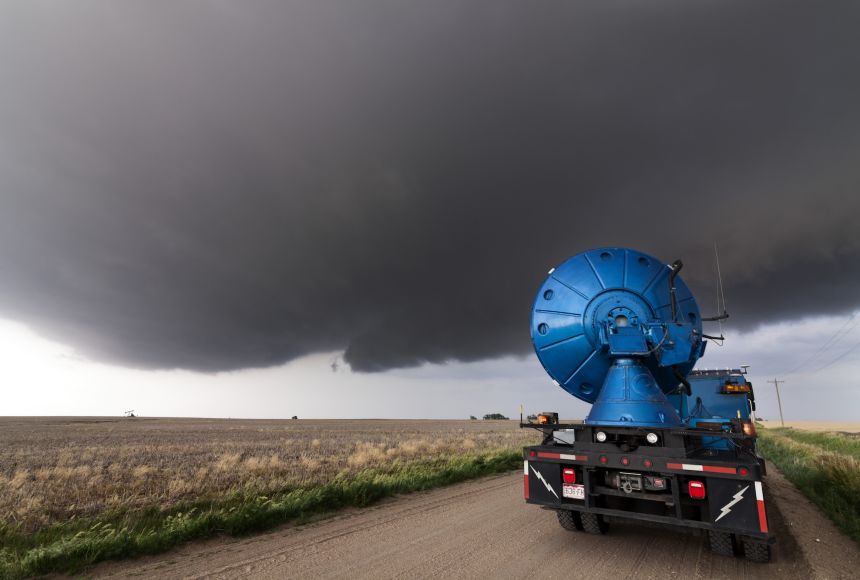
Weather Radar Truck
Weather scientists travel around the world all year trying to learn more about storms and how to keep people safe. Radar trucks like these are used to better understand the severity of storms and tornados.
Photograph by Ryan McGinnis
Look up at the sky. Is it raining or sunny? Are there big, puffy clouds that look like marshmallows, or dark, angry clouds threatening sleet? No matter how the sky appears, you are looking at Earth’s lower atmosphere, the realm that is studied by the science of meteorology. Meteorology concerns itself with the science of atmospheric properties and phenomena—science that includes the atmosphere’s physics and chemistry.
Meteorologists are often thought of as people who forecast the weather. And some meteorologists certainly do that! Predicting the weather is a complicated process, which requires both sophisticated new tools and some old-fashioned techniques. Meteorologists are observers and researchers. They note the physical conditions of the atmosphere above them, and they study maps, satellite data, and radar information. They also compare various kinds of weather data from local, regional, and global sources.
Beyond weather forecasting, meteorology is concerned with long-term trends in climate and weather, and their potential impact on human populations. An important area of meteorological research these days is climate change and the effects it may cause.
Many people wonder why the study of the atmosphere is called meteorology. The name comes from the ancient Greeks. In about 340 B.C.E., the Greek philosopher Aristotle wrote a book called Meteorologica, which contained all that was known at the time about weather and climate. Aristotle got the title of his book from the Greek word “meteoron,” which meant “a thing high up” and referred to anything observed in the atmosphere. That term stuck through the centuries, so experts on the atmosphere became known as meteorologists.
Credits
Media Credits
The audio, illustrations, photos, and videos are credited beneath the media asset, except for promotional images, which generally link to another page that contains the media credit. The Rights Holder for media is the person or group credited.
Director
Author
Production Manager
Program Specialists
Specialist, Content Production
Producer
other
Last Updated
October 19, 2023
User Permissions
For information on user permissions, please read our Terms of Service. If you have questions about how to cite anything on our website in your project or classroom presentation, please contact your teacher. They will best know the preferred format. When you reach out to them, you will need the page title, URL, and the date you accessed the resource.
Media
If a media asset is downloadable, a download button appears in the corner of the media viewer. If no button appears, you cannot download or save the media.
Text
Text on this page is printable and can be used according to our Terms of Service.
Interactives
Any interactives on this page can only be played while you are visiting our website. You cannot download interactives.