ENCYCLOPEDIC ENTRY
ENCYCLOPEDIC ENTRY
Natural Selection
Natural Selection
Natural selection is the process through which species adapt to their environments. It is the engine that drives evolution.
Grades
8 - 12
Image
On the Origin of Species
English naturalist Charles Darwin wrote the definitive book outlining his idea of natural selection, On the Origin of Species. The book chronicled his studies in South America and Pacific islands. Published in 1859, the book became a best seller.
Photograph by Ian Forsyth via Getty Images
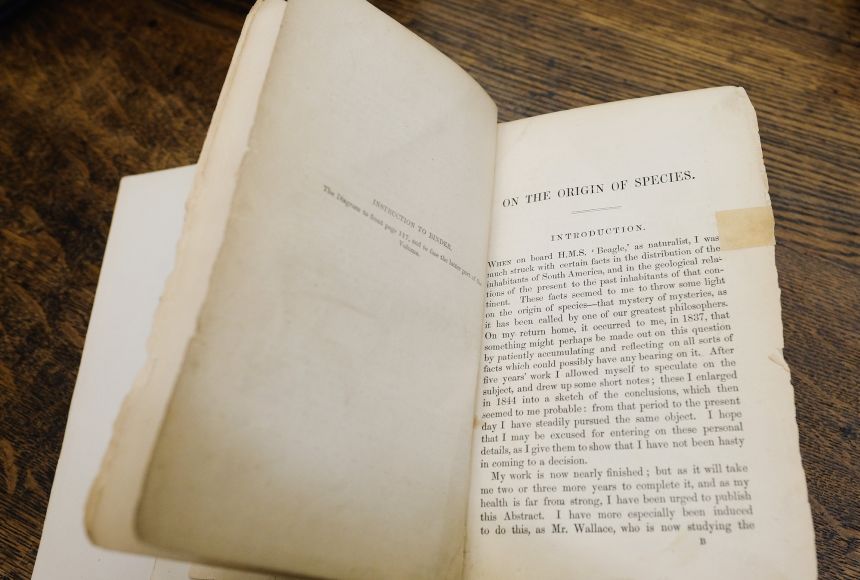
English naturalist Charles Darwin developed the idea of natural selection after a five-year voyage to study plants, animals, and fossils in South America and on islands in the Pacific. In 1859, he brought the idea of natural selection to the attention of the world in his best-selling book, On the Origin of Species.
Natural selection is the process through which populations of living organisms adapt and change. Individuals in a population are naturally variable, meaning that they are all different in some ways. This variation means that some individuals have traits better suited to the environment than others. Individuals with adaptive traits—traits that give them some advantage—are more likely to survive and reproduce. These individuals then pass the adaptive traits on to their offspring. Over time, these advantageous traits become more common in the population. Through this process of natural selection, favorable traits are transmitted through generations.
Natural selection can lead to speciation, where one species gives rise to a new and distinctly different species. It is one of the processes that drives evolution and helps to explain the diversity of life on Earth.
Darwin chose the name natural selection to contrast with “artificial selection,” or selective breeding that is controlled by humans. He pointed to the pastime of pigeon breeding, a popular hobby in his day, as an example of artificial selection. By choosing which pigeons mated with others, hobbyists created distinct pigeon breeds, with fancy feathers or acrobatic flight, that were different from wild pigeons.
Darwin and other scientists of his day argued that a process much like artificial selection happened in nature, without any human intervention. He argued that natural selection explained how a wide variety of life forms developed over time from a single common ancestor.
Darwin did not know that genes existed, but he could see that many traits are heritable—passed from parents to offspring.
Mutations are changes in the structure of the molecules that make up genes, called DNA. The mutation of genes is an important source of genetic variation within a population. Mutations can be random (for example, when replicating cells make an error while copying DNA), or happen as a result of exposure to something in the environment, like harmful chemicals or radiation.
Mutations can be harmful, neutral, or sometimes helpful, resulting in a new, advantageous trait. When mutations occur in germ cells (eggs and sperm), they can be passed on to offspring.
If the environment changes rapidly, some species may not be able to adapt fast enough through natural selection. Through studying the fossil record, we know that many of the organisms that once lived on Earth are now extinct. Dinosaurs are one example. An invasive species, a disease organism, a catastrophic environmental change, or a highly successful predator can all contribute to the extinction of species.
Today, human actions such as overhunting and the destruction of habitats are the main cause of extinctions. Extinctions seem to be occurring at a much faster rate today than they did in the past, as shown in the fossil record.
Credits
Media Credits
The audio, illustrations, photos, and videos are credited beneath the media asset, except for promotional images, which generally link to another page that contains the media credit. The Rights Holder for media is the person or group credited.
Director
Author
Production Managers
Program Specialists
Producer
Intern
other
Last Updated
August 20, 2026
User Permissions
For information on user permissions, please read our Terms of Service. If you have questions about how to cite anything on our website in your project or classroom presentation, please contact your teacher. They will best know the preferred format. When you reach out to them, you will need the page title, URL, and the date you accessed the resource.
Media
If a media asset is downloadable, a download button appears in the corner of the media viewer. If no button appears, you cannot download or save the media.
Text
Text on this page is printable and can be used according to our Terms of Service.
Interactives
Any interactives on this page can only be played while you are visiting our website. You cannot download interactives.