ARTICLE
ARTICLE
In New Drainage Projects, Long-Buried Urban Streams See the Light Again
In New Drainage Projects, Long-Buried Urban Streams See the Light Again
Innovative techniques that mimic nature help restore open waterways, prevent pollution, and create habitats for animals.
Grades
5 - 12
Subjects
Earth Science, Geology, Geography, Physical Geography
Image
Stream
Image of a stream running over rocks in a neighborhood.
Photograph courtsey of Underwood and Associates
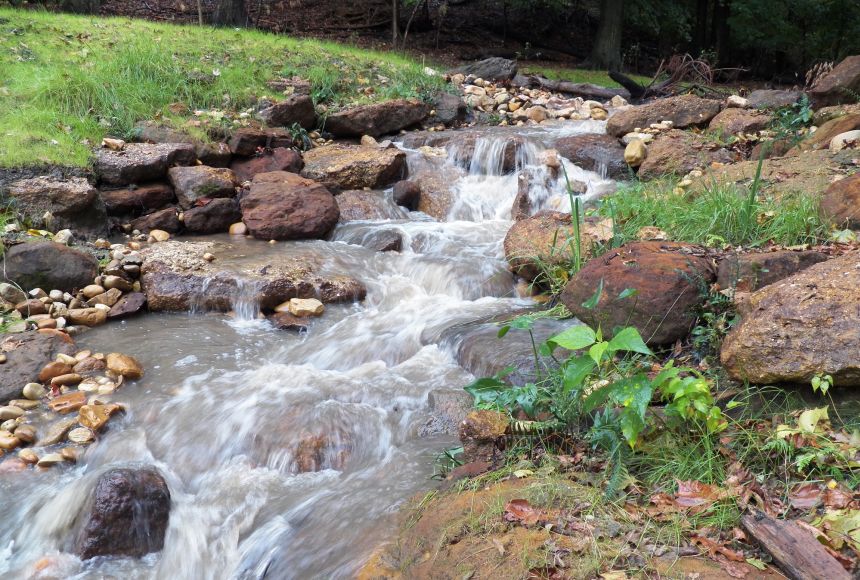
Washington—A small stream gurgles under a historic stone bridge, once used by Revolutionary War patriots to transport supplies. For more than a century, the bridge was bricked up, the stream beneath it just a dry, eroded channel.
As in many places, this tributary of the Broad Branch stream had been forced underground around the turn of the century, through a program designed to rid Washington, D.C., of surface water. At the time, malaria was a major killer, and cities around the world were draining any kind of standing water or "swamp," out of both a fear of mosquito-borne disease and a desire to create more land for development.
Burying streams created other problems, though. When the little stream and its tributary in the Rock Creek area of northwest Washington were channeled into a buried pipe, they carried away not only the runoff from this leafy section of the city but also pollution, which would make its way to the beleaguered Chesapeake Bay. Other cities saw similar problems. What's more, paving and piping often make flooding worse.
That's why in recent years many cities have been undoing the past century's drainage projects, uncovering or "daylighting" buried streams.
On a recent overcast fall morning, Keith Underwood gave National Geographic a tour of what is once again a picturesque stream in the nation's capital. Trees muffled the sound of traffic on 36th Street and Linnean Avenue, as dragonflies darted overhead, chasing gnats.
"This is the first time there's been a stream here in a hundred years," said Underwood, a landscape architect based in Annapolis, Maryland, who was hired by the city to restore the stream in the Rock Creek watershed.
Underwood is leading a movement that brings such streams back to the surface in a new way—using innovative techniques that mimic nature. Unlike other high-profile streams that have been daylighted in New York, Michigan, Korea, and other places over the past few decades, Underwood's streams don't wend through concrete channels. And they're banked with natural materials like soil and rock to slow erosion and runoff. Yet his techniques have sometimes put him at odds with regulators.
So far Underwood has designed and finished roughly 50 restoration projects in the region, and his new approach is beginning to influence other work around the country.
"What we're trying to do is re-create the condition of original headwater streams, to provide habitat and prevent pollution," says Steve Saari, who manages the Washington, D.C., projects as a watershed specialist with the District's Department of the Environment.
Remaking a Stream
Before Europeans arrived, the Rock Creek drainage area would have been covered in evergreen swamp, says Steve Dryden, who promotes habitat restoration in the area as director of the environmental group Rock Creek Songbirds.
But after engineers buried the streams, he says, those pipes became "conveyor belts for pollution." Every time it rained, oil, fertilizers, and pesticides were flushed into Rock Creek, which flows into the Potomac River and then the Chesapeake Bay.
To re-create the original streams, Underwood unblocked the bottoms of bridges and removed old drainage pipes. Next, he lined the bottom of the former stream channels with perforated pipe. He laid down large cobblestones, gathered from the area, then gravel and sand, a by-product of mining operations in the region. Then he mixed in wood chips, a concept he'd developed himself.
The wood chips are soon invaded by fungi, he explains. "Beetle larvae eat the fungi, which then makes space for plant roots to grow," he says. "That makes even more spaces in the soil, which allows water to seep easier into the ground."
Underwood reconstructed the streams to have a gradual slope, so that they more closely resemble a series of small, stepped ponds than a single river. Small bumps and sand mounds slow water down and cause it to spread out, mimicking the actions of beavers or logjams in a natural stream.
The net effect is that less sediment washes into the bay, even as the water keeps moving. That's important because stagnant water could smell bad or harbor mosquitoes.
As a bonus, Underwood says, nitrogen and phosphorous fertilizers that wash off people's lawns now get gobbled up by organisms such as plants and bacteria in the new stream, instead of becoming pollutants that feed algae and cause dead zones downstream.
These biological processes are helped along by what Underwood calls "coarse wood," or logs from the city's tree trimming. Placing a few logs in the stream "adds organic carbon to the food web, which is really important," he says. Insects and microbes feast on and live in the wood, then become food for larger animals.
Underwood calls his work "regenerative design." Natural systems respond to change over time, he says, unlike man-made filter systems, which eventually fail. "It's a work of art as much as engineering," he says of his process, which he's been refining over the past couple of decades and on which a patent is pending.
As the system weathers and matures, scientists from the University of Maryland Center for Environmental Science will monitor the restoration and measure its impact on water quality.
Healthy Habitat?
Underwood says the Washington, D.C., restoration projects are already providing habitat for animals. Amphibians such as dusky salamanders, wood frogs, and spring peepers have turned up, as have turtles and ducks; mammals such as deer, raccoons, and opossums; and a host of invertebrates, including crayfish, caddis flies, and about a dozen species of dragonflies. He hopes migratory warblers will also use the habitat.
Long-term plans include planting more kinds of vegetation, such as native cranberries and shrubs, to supplement the new clumps of blue flag iris, pickerelweed, and arrow arum. Because the area had been denuded for so long, there was no stock of native seeds left in the ground, so all the plants had to be brought in.
And if he can get funding and approval, Underwood would like to continue the Broad Branch project about 61 meters (200 feet), to connect it to Rock Creek. That link, he says, could give ocean fish like herring and shad the chance to run all the way up to the new habitat.
During the tour, a middle-aged man pulled his car over to ask what Underwood was up to. "I drive by here every day, and now it looks much more picturesque," said Jim Sweeney, who lives in the area.
Sweeney's only question for Underwood was whether the water would lead to mosquitoes.
In all of his projects, Underwood said, he's seen "virtually no mosquitoes." The fact that the water keeps moving makes it hard for the insects to lay their eggs, and the habitat supports an array of mosquito-chomping predators, such as the dragonflies and frogs.
Regulatory Resistance
Getting the projects done wasn't easy. The $1.75 million Broad Branch and Linnean projects were paid for by grants from the U.S. Environmental Protection Agency and fees the District levies on property with impervious pavement. To implement it, Saari had to work not only with the EPA but also several city agencies, the National Park Service, and the Peruvian Embassy.
"The most significant obstacle to this type of work has been regulatory agencies," says Underwood.
Saari says the Broad Branch project was initially denied an EPA permit in 2010. The EPA was concerned that the restored stream wouldn't be stable and that the project would involve treating pollutants in the landscape, instead of preventing them from hitting the landscape in the first place.
"The EPA and Army Corps of Engineers are used to stream design techniques that involve hardening of banks," says Saari. (The corps issues permits, and the EPA reviews them.) Underwood's approach aims to both stabilize stream banks, which prevents erosion, and create habitat.
Maryland's Department of the Environment has opposed some of Underwood's projects in that state, though the agency did not respond to requests for comment.
"Daylighting streams and trying to make good habitat out of it is a fine goal, and the track record for building these things is quite good," says Randy Pomponio, who oversees environmental assessments for the EPA's mid-Atlantic region. "But we want to make sure that no harm is done."
He says that his agency and the Army Corps of Engineers have granted permits to 48 of 49 proposed regenerative stream projects in the region.
Stream restoration is just one part of a broader effort to improve water quality, Underwood says, which should also include going after polluters and educating landowners about eco-friendly practices. His approach is especially well suited to park and forest areas, he adds, because it leads to less vegetation loss and less disturbance of the land than traditional stream-building techniques.
Pomponio and Underwood agree on the ultimate goal: restored watersheds that are as natural as possible.
Originally published by natgeo.com on November 27, 2014.
Credits
Media Credits
The audio, illustrations, photos, and videos are credited beneath the media asset, except for promotional images, which generally link to another page that contains the media credit. The Rights Holder for media is the person or group credited.
Director
Author
Production Managers
Program Specialists
Producer
other
Last Updated
April 23, 2024
User Permissions
For information on user permissions, please read our Terms of Service. If you have questions about how to cite anything on our website in your project or classroom presentation, please contact your teacher. They will best know the preferred format. When you reach out to them, you will need the page title, URL, and the date you accessed the resource.
Media
If a media asset is downloadable, a download button appears in the corner of the media viewer. If no button appears, you cannot download or save the media.
Text
Text on this page is printable and can be used according to our Terms of Service.
Interactives
Any interactives on this page can only be played while you are visiting our website. You cannot download interactives.