ENCYCLOPEDIC ENTRY
ENCYCLOPEDIC ENTRY
Point Source and Nonpoint Sources of Pollution
Point Source and Nonpoint Sources of Pollution
For the purposes of regulation, the United States Environmental Protection Agency identifies two broad categories of pollution: point-source pollution and nonpoint-source pollution.
Grades
5 - 8
Subjects
Biology, Ecology, Conservation, Earth Science, Oceanography
Image
River Pollution
The bank of a river covered in trash and oil.
Photograph by nomadFra
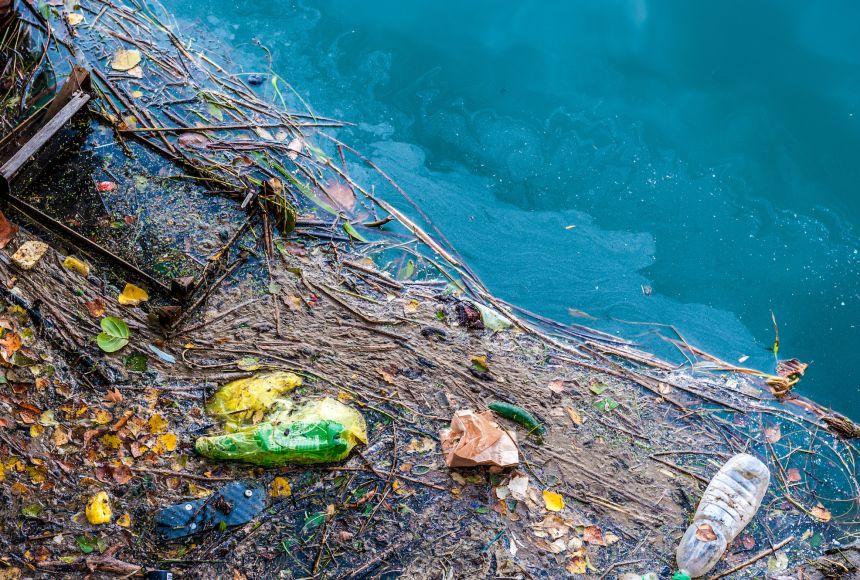

Almost everything humans do, from growing food to manufacturing products to generating electricity, has the potential to release pollution into the environment. Regulatory agencies charged with protecting the environment identify two main categories of pollution: point-source and nonpoint-source pollution.
Point-source pollution is easy to identify. As the name suggests, it comes from a single place. Nonpoint-source pollution is harder to identify and harder to address. It is pollution that comes from many places, all at once.
The United States Environmental Protection Agency (EPA) defines point source pollution as any contaminant that enters the environment from an easily identified and confined place. Examples include smokestacks, discharge pipes, and drainage ditches.
Factories and power plants can be a source of point-source pollution, affecting both air and water. Smokestacks may spew carbon monoxide, heavy metal, sulfur dioxide, nitrogen dioxide, or “particulate matter” (small particles) into the air. Oil refineries, paper mills, and auto plants that use water as part of their manufacturing processes can discharge effluent—wastewater containing harmful chemical pollutants—into rivers, lakes, or the ocean.
Municipal wastewater treatment plants are another common source of point-source pollution. Effluent from a treatment plant can introduce nutrients and harmful microbes into waterways. Nutrients can cause a rampant growth of algae in water.
Nonpoint-source pollution is the opposite of point-source pollution, with pollutants released in a wide area. As an example, picture a city street during a thunderstorm. As rainwater flows over asphalt, it washes away drops of oil that leaked from car engines, particles of tire rubber, dog waste, and trash. The runoff goes into a storm sewer and ends up in a nearby river. Runoff is a major cause of nonpoint-source pollution. It is a big problem in cities because of all the hard surfaces, including streets and roofs. The amount of pollutants washed from a single city block might be small, but when you add up the miles and miles of pavement in a big city you get a big problem.
In rural areas, runoff can wash sediment from the roads in a logged-over forest tract. It can also carry acid from abandoned mines and flush pesticides and fertilizer from farm fields. All of this pollution is likely to wind up in streams, rivers, and lakes.
Airborne pollutants are major contributors to acid rain. It forms in the atmosphere when sulfur dioxide and nitrogen oxides combine with water. Because acid rain results from the long-range movement of those pollutants from many factories and power plants, it is considered nonpoint-source pollution.
In the United States, the Clean Air Act and the Clean Water Act have helped to limit both point-source and nonpoint-source pollution. Thanks to these two legislative initiatives, in effect for some 50 years now, America’s air and water are cleaner today than they were for most of the 20th century.
Credits
Media Credits
The audio, illustrations, photos, and videos are credited beneath the media asset, except for promotional images, which generally link to another page that contains the media credit. The Rights Holder for media is the person or group credited.
Director
Author
Production Managers
Program Specialists
Producer
other
Last Updated
October 1, 2024
User Permissions
For information on user permissions, please read our Terms of Service. If you have questions about how to cite anything on our website in your project or classroom presentation, please contact your teacher. They will best know the preferred format. When you reach out to them, you will need the page title, URL, and the date you accessed the resource.
Media
If a media asset is downloadable, a download button appears in the corner of the media viewer. If no button appears, you cannot download or save the media.
Text
Text on this page is printable and can be used according to our Terms of Service.
Interactives
Any interactives on this page can only be played while you are visiting our website. You cannot download interactives.