ARTICLE
ARTICLE
Putting the "Me" in Biome
Putting the "Me" in Biome
Scientists are amending the traditional definition of biomes to include humans as part of the environment.
Grades
5 - 12
Subjects
Anthropology, Biology, Ecology, Conservation, Geography, Human Geography
Image
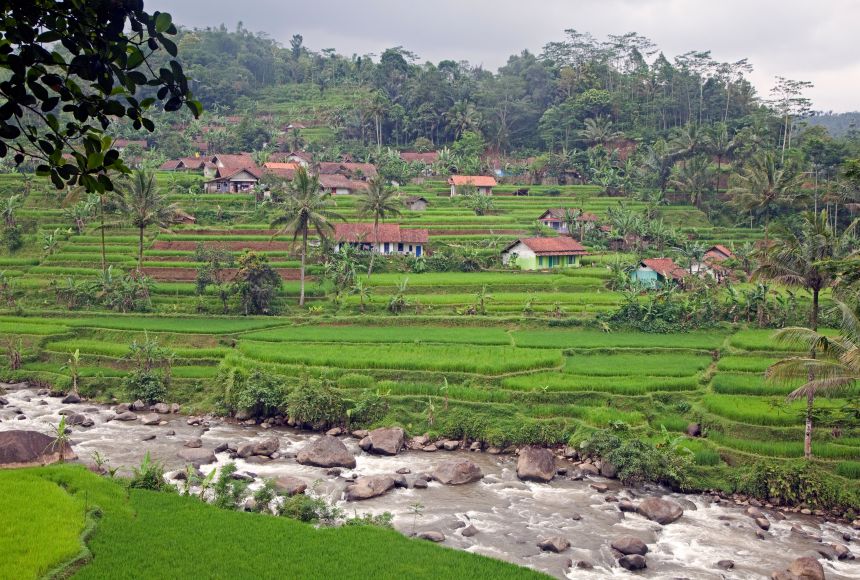
Indonesian Village Field
A rural village surrounded by fields of rice paddies. This Javanese village is in Garut Regency, West Java, Indonesia—shown during the rainy season.
Photograph courtesy of Alamy Stock Photo
Northwestern coniferous forest, boreal forest, and tundra are just a few of the labels scientists have used to describe the biomes of the world. Biomes are classified based on the local environmental conditions and the living organisms, particularly the flora, or plants. The living organisms that make up a biome also influence the biochemical processes that surround it, such as the carbon cycle. However, one living organism has been missing from traditional biome classifications.
Humans have been influencing and altering our environments since we first emerged—so much so that scientists have dubbed the current era the Anthropocene, meaning the geological age dominated by human activity. Just as human activities have transformed and evolved over time, so have the places and biomes they inhabit. For instance, hunting may have contributed to the extinction of some megafauna, and the controlled burning of forests dramatically altered their landscape. More dramatic and rapid changes began to occur after the Industrial Revolution, when advancements in technology opened up previously unexplored avenues. Prior to the Industrial Revolution, in the 1700s, almost half the world was covered in wilderness, but current estimates indicate that just 23 percent of the world remains wild and untouched by human industrialization.
As of 2018, Earth’s human population is over 7.5 billion, and this growing population means an increase in human influence. In fact, more places on Earth are affected and influenced by humans than not. In many ways, humans can be considered ecosystem engineers, having fundamentally altered the ecological and biochemical processes around them. Through landscape modifications and natural resource use, humans have altered over 75 percent of the ice-free land on Earth.
Scientists, such as Erle Ellis from the Laboratory for Anthropogenic Landscape Ecology at the University of Maryland, and Navin Ramakutty at McGill University, are beginning to recognize the integral role humans play within the biomes they reside. They call these terrestrial biomes where humans dwell anthropogenic biomes or anthromes. This novel paradigm contrasts with the more traditional idea that humans are independent of the natural world.
“If you open atlases or global change textbooks, you see maps of biomes of the world. This is how you depict what the world looks like,” Ramakutty said in an interview with NASA. “We know instinctively that this is not what the world looks like any more.”
Ellis and Ramakutty state there are eighteen anthromes and, like the traditional biome classifications, human biomes are defined by the resident flora and the climate. Population density, land use, and land cover are other factors used to classify anthromes. These classifications also include the ecosystems they have affected through their activities.
Ellis and Ramakutty’s eighteen anthromes fall into six categories:
Dense Settlements/Urban: These anthromes are the most densely populated by humans and by definition have a population density of 100 persons per kilometer or greater. Urban settlements are highly developed environments with a high population density, and these areas typically have high carbon and nitrogen emissions. These anthromes are most common in Europe and Asia and include approximately 2.6 billion people and cover an area of 1.5 million square kilometers (0.6 million square miles).
Village: Villages are usually dominated by rural populations that are dependent on agriculture. These anthromes tend to grow food for local use and include Rice Villages and Pastoral Villages. Over 80 percent of the world’s population lives in urban areas and villages, however, these biomes only make up around 7 percent of the ice-free land on Earth. Many village anthromes are located in China and India. In total, about 2.6 billion people live in village anthromes, which are spread over about 8 million square kilometers (3.1 million square miles).
Cropland: These anthromes are characterized by low population density and large areas of crops, which are irrigated and sent to non-local populations. These areas include about a quarter of the global tree cover and are home to 0.9 billion people over an area of 27 million square kilometers (10.4 million square miles).
Rangeland: This anthrome covers almost one-third of the ice-free surface of Earth, making it the largest anthrome in terms of land cover. Rangelands tend to have lower human population densities and host grazing livestock. Rangelands are less altered by humans than other biomes, as many of these areas were developed on grasslands and savannas, which naturally have low tree cover. Examples of rangelands can be found in Central Asia and the western United States.
Forest: High tree cover and low population density define forests. There is relatively little human intervention in these areas compared to croplands, rangelands, and dense settlements. However, valuable resources, such as lumber, are gathered from these areas, which often makes them the target of human activities. Forest anthromes take up 25 million square kilometers (9.6 square miles) of space and have a combined population of 40 million.
Wildlands: These areas are defined by a lack of human population or use. Wildlands make up approximately 20 percent of Earth’s ice-free surface and may or may not have significant tree cover. These lands are generally inhospitable to humans and are otherwise unfavorable for human use.
The ubiquitous nature of human impact on ecosystems means significant changes to biodiversity and the rate of extinction. Human activities such as agriculture and logging often result in habitat loss or the introduction of invasive species, leaving native species vulnerable.
In the early days, biomes were classified by appearance—or physiognomy. Now, researchers like Ellis have access to modern technological advances, such as remote sensing from satellites, which allows them to redefine and classify biomes more precisely and accurately. Ecologists and other conservationists have relied on defining biomes to understand the ecological needs of a particular area. Having a more accurate and encompassing understanding of our biosphere provides us with the appropriate tools to successfully conserve it.
Credits
Media Credits
The audio, illustrations, photos, and videos are credited beneath the media asset, except for promotional images, which generally link to another page that contains the media credit. The Rights Holder for media is the person or group credited.
Director
Author
Production Managers
Program Specialists
Producer
Intern
other
Last Updated
August 14, 2026
User Permissions
For information on user permissions, please read our Terms of Service. If you have questions about how to cite anything on our website in your project or classroom presentation, please contact your teacher. They will best know the preferred format. When you reach out to them, you will need the page title, URL, and the date you accessed the resource.
Media
If a media asset is downloadable, a download button appears in the corner of the media viewer. If no button appears, you cannot download or save the media.
Text
Text on this page is printable and can be used according to our Terms of Service.
Interactives
Any interactives on this page can only be played while you are visiting our website. You cannot download interactives.