ARTICLE
ARTICLE
Rainforest
Rainforest
A rainforest is an area of tall trees that receives a high amount of rainfall.
Grades
9 - 12+
Subjects
Biology, Ecology, Geography

Loading ...
A rainforest is an area of tall, mostly evergreen trees that receives a high amount of rainfall. Rainforests are likely Earth’s oldest living ecosystems, with some surviving in their present form for at least 60 million years. They are incredibly diverse and complex, with more than half of the world’s plant and animal species calling rainforests their home—even though they cover just two to six percent of Earth’s surface. This makes rainforests astoundingly dense with flora and fauna.
Rainforests thrive on every continent except Antarctica. The largest rainforests on Earth surround the Amazon River in South America and the Congo River in Africa. The tropical islands of Southeast Asia and parts of Australia also support dense rainforest habitats. Even the cool evergreen forests in North America’s Pacific Northwest and in Northern Europe are considered rainforests.
The rich biodiversity of rainforests is incredibly important to the well-being of our planet and all of its inhabitants, including humans. One major role of rainforests is to help regulate the global climate. Because rainforests are so big, they help regulate global climate by storing excess carbon dioxide in the trees and soil. This helps control the temperature in the regions around rainforests. The trees also provide water vapor to help cloud formation.
But unsustainable industrial and agricultural development have severely degraded the health of the world’s rainforests. Though people, governments, intergovernmental organizations and conservation groups have made efforts to protect these invaluable but fragile ecosystems, other factors—such as pressure from international markets for meat and other products, lack of enforcement of regulations on corporate practices and outdated political frameworks—make conservation an ongoing challenge.
Rainforest Structure
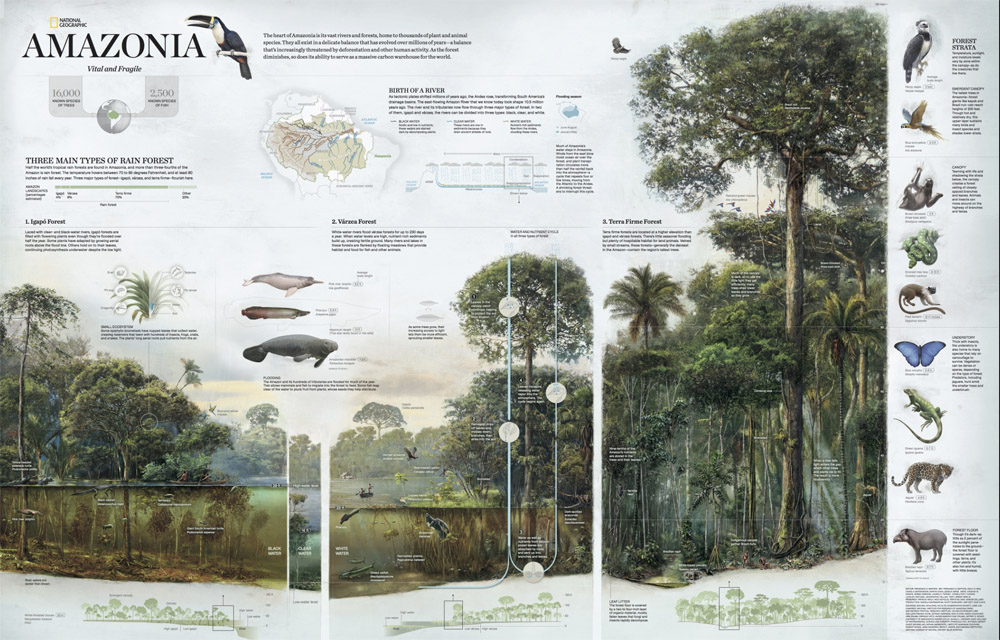
Most rainforests are structured in four layers: emergent, canopy, understory and forest floor. Each layer has unique characteristics based on differing levels of water, sunlight and air circulation. While each layer is distinct, they exist in an interdependent system: processes and species in one layer influence those in another.
Emergent Layer
The top layer of the rainforest is the emergent layer. Here, trees as tall as 60 meters (200 feet) dominate the skyline. Foliage is often sparse on tree trunks, but spreads wide as the trees reach the sunny upper layer, where they photosynthesize the sun’s rays. In this layer, strong winds carry and spread lightweight seeds from the parent plant.
In the Amazon rainforest, the towering trees of the emergent layer include the Brazil nut tree (Bertholletia excelsa) and the kapok tree (Ceiba pentandra). The Brazil nut tree, a vulnerable species, can live up to 1,000 years in undisturbed rainforest habitats.
Animals often maneuver through the emergent layer’s unstable topmost branches by flying or gliding. Animals that cannot fly or glide are usually quite small, as they need to be light enough to be supported by a tree’s slender uppermost layers.
The animals living in the emergent layer of the Amazon rainforest include birds, bats, gliders and butterflies. Large raptors, such as harpy eagles (Harpia harpyja), are its top predators.
In Australian rainforests, pygmy gliders (Acrobates pygmaeus) populate the emergent layer. Pygmy gliders are marsupials, and they get their name from the way the flaps of skin between their legs allow them to glide from branch to branch.
Bats are the most diverse mammal species in most tropical rainforests, and they regularly fly throughout the emergent, canopy and understory layers. For instance, one of the world’s largest species of bat, the Madagascan flying fox (Pteropus rufus)—found on the African island of Madagascar—is an important pollinator that mainly feeds on juice from fruit but will also chew flowers for their nectar.
Canopy Layer
Beneath the emergent layer is the canopy, a deep layer of vegetation roughly six meters (20 feet) thick. The canopy’s dense network of leaves and branches forms a "roof" over the two remaining layers.
The canopy blocks winds, rainfall and sunlight, creating a humid, still and dark environment below. Trees have adapted to this damp environment by producing glossy leaves with pointed tips that repel water.
While trees in the emergent layer rely on wind to scatter their seeds, many canopy plants, lacking wind, encase their seeds in fruit. Enticed by the sweet offering, animals eat the fruit and deposit seeds on the forest floor as droppings. Fig trees, common throughout most of the world’s tropical rainforests, may be the most familiar fruit tree in the canopy.
With so much food available, more animals live in the canopy than in any other layer in the rainforest. Many—but not all—canopy dwellers are notable for their shrill or frequent vocalizing. In the Amazon rainforest, canopy fruit is snatched up in the large beaks of screeching scarlet macaws (Ara macao) and keel-billed toucans (Ramphastos sulfuratus), and picked by barking spider monkeys (Ateles) and howler monkeys (Alouatta). The silent two-toed sloth (Choloepus) chews on the leaves, shoots and fruit in the canopy.
Thousands of insect species can also be found in the canopy, from bees to beetles, borers to butterflies. Insects are an important part of the diet of the canopy’s reptiles, including the "flying" Draco lizards of Southeast Asia.
National Geographic Explorer and ecologist Nalini Nadkarni is a foremost expert in studying the plants and animals (or biota) that live in rainforest canopies around the world. She has discovered that the canopy is a separate but deeply interrelated part of forest ecosystems. Nadkarni now serves as a National Geographic Explorer at Large, creatively engaging people from all walks of life on the importance of understanding and protecting nature. Through her approach of “tapestry thinking,” Nadkarni makes connections between seemingly disconnected sectors of society and ways of knowing to amplify the power of nature.
Understory Layer
Located several meters below the canopy, the understory is an even darker, stiller and more humid environment. Plants here, such as palms, are much shorter and have larger leaves than the plants that dominate the canopy. The large leaves of understory plants are able to catch the minimal sunlight reaching beyond the dense canopy.
Understory plants often produce bright flowers, such as Heliconia, native to the Americas and the South Pacific. Others have a strong smell, such as orchids. These features attract pollinators even in the understory’s low-light conditions.
The fruit and seeds of some understory shrubs in temperate rainforests are edible. The temperate rainforests of North America, for example, are known to feature shrubs with berries.
Animals call the understory home for a variety of reasons. Many take advantage of the dimly lit environment for camouflage. The spots on a jaguar (Panthera onca) -- found in the rainforests of Central and South America -- may be mistaken for leaves or flecks of sunlight, for instance. The green mamba (Dendropaspis viridis), one of the deadliest snakes in the world, blends in with foliage as it slithers up branches in the Congo rainforest. Many bats, birds and insects prefer the open airspace the understory offers. Amphibians, such as dazzlingly colored tree frogs, thrive in the humidity because it keeps their skin moist.
Central Africa’s tropical rainforest canopies and understories are home to some of the most endangered and familiar rainforest animals—such as forest elephants (Loxodonta cyclotis), pythons, antelopes and gorillas. Gorillas -- a group of primates consisting of two critically endangered species, eastern gorillas (Gorilla beringei) and western gorillas (Gorilla gorilla) -- are crucial for seed dispersal. Gorillas are herbivores that move throughout the dark, dense rainforest as well as more sun-dappled swamps. Their droppings disperse seeds in these sunny areas where new trees and shrubs can take root. In this way, gorillas are keystone species in many African rainforest ecosystems.
Forest Floor Layer
The forest floor is the darkest of all rainforest layers, making it extremely difficult for plants to grow. Instead, this layer is the main site of decomposition. When leaves fall to the forest floor, they decay quickly.
Decomposers, such as termites, slugs, worms and fungi, thrive on the forest floor. Organic matter falls from trees and plants, and these organisms break down the decaying material into nutrients. The shallow roots of rainforest trees absorb these nutrients and dozens of predators consume the decomposers.
Animals such as collared peccaries (Pecari tajacu), armadillos and anteaters forage in the decomposing brush for these tasty insects, roots and tubers of the South American rainforest. Even larger predators, including leopards, skulk in the darkness to surprise their prey. Smaller rodents, such as rats and lowland pacas (Cuniculus paca)—a type of striped rodent indigenous to Central and South America—hide from predators beneath the shallow roots of trees that rise through the other layers.
Rivers that run through some tropical rainforests create unusual freshwater habitats on the forest floor. The Amazon River, for instance, is home to the boto (Inia geoffrensis), or pink river dolphin, one of the few freshwater dolphin species in the world. National Geographic Explorer and marine biologist Fernando Trujillo works to protect those river dolphins and their habitats in the Amazon, as river dolphins act as barometers of the health of aquatic ecosystems. The Amazon is also home to black caimans (Melanosuchus niger), large reptiles related to alligators, while the Congo River is home to the caimans’ crocodilian cousin, the Nile crocodile (Crocodylus niloticus).
Types of Rainforests
Tropical Rainforests
Tropical rainforests are mainly located in the tropics, between the latitudes of 23.5°N (the Tropic of Cancer) and 23.5°S (the Tropic of Capricorn)—the tropics. Tropical rainforests are found in Central and South America, western and central Africa, western India, Southeast Asia, the island of New Guinea, and Australia.
Sunlight strikes the tropics almost straight on, producing intense solar energy that keeps temperatures high -- between 18° and 30°C (64° and 85°F). High temperatures keep the air warm and wet, with an average humidity of between 77 percent and 88 percent. Such humid air produces extreme and frequent rainfall, with average yearly rainfall ranging from roughly 180-250 centimeters (70-98 inches) in tropical rainforests. Tropical rainforests are so warm and moist that they produce as much as 75 percent of their own rain through evaporation and transpiration.
Such ample sunlight and moisture are the essential building blocks for the diverse flora and fauna living in tropical rainforests. Roughly half of the world’s known species can be found in tropical rainforests, with as many as 400 species of trees present in a single hectare.
Tropical rainforests are some of the most biologically diverse terrestrial ecosystems in the world. The Amazon rainforest is the world’s largest tropical rainforest. It is home to around 40,000 plant species, nearly 1,300 bird species, 3,000 types of fish, more than 430 species of mammals and 2.5 million different insects. Red-bellied piranhas (Pygocentrus nattereri) and pink river dolphins swim its waters. Jewel-toned parrots squawk and fly through its trees. Poison dart frogs (Dendrobates) warn off predators with their bright colors. Capuchin (Cebus) and spider monkeys swing and scamper through the branches of the rainforest’s estimated 400 billion trees. Millions of mushrooms and other fungi decompose dead and dying plant material, recycling nutrients to the soil and organisms in the understory. The Amazon rainforest is truly an ecological kaleidoscope, full of colorful sights and sounds.
Temperate Rainforests
Temperate rainforests are located in the mid-latitudes, where temperatures are much milder than the tropics. Temperate rainforests are found mostly in coastal, mountainous areas. These geographic conditions help create areas of high rainfall. Temperate rainforests can be found on the coasts of the Pacific Northwest in North America, Chile, the United Kingdom, Norway, Japan, New Zealand and southern Australia.
As their name implies, temperate rainforests are much cooler than their tropical counterparts. They are also both less sunny and less rainy, though they still receive at least 140 centimeters (55 inches) of rain per year.
Cooler temperatures and a more stable climate slow down decomposition, allowing more material to accumulate. The old-growth forests of the Pacific Northwest, for example, store more biomass than tropical rainforests.
This productivity allows many plant species to grow for incredibly long periods of time. Temperate rainforest trees, such as the coast redwood (Sequoia sempervirens) in the U.S. state of California and the alerce (Fitzroya cupressoides) in Chile are among the oldest and largest tree species in the world.
The animals of the temperate rainforest include mostly large and small mammals, small birds, insects and reptiles. These species vary widely between rainforests in different world regions. Bobcats (Lynx rufus), mountain lions (Puma concolor) and black bears (Ursus americanus) are major predators in the rainforests of the Pacific Northwest. In Australia, ground dwellers, such as wallabies, bandicoots and potoroos (Potorous; small marsupials that are among Australia’s most endangered animals), feast on the foods provided by the forest floor. Chile’s rainforests are home to a number of unique birds, such as the Magellanic woodpecker (Campephilus magellanicus) and the Juan Fernández firecrown (Sephanoides fernandensis), a hummingbird species that is endemic to one island off the coast.
State of the Rainforests
Human activities, such as clearing land for agricultural development and pollution from industrial activities, have greatly diminished the health of the world’s rainforests. Demand for meat and other products, a lack of enforcement of corporate regulations and the legacies of economic and political frameworks that emphasize profit over conservation make conservation an ongoing challenge. For example, the economic demands for natural resources from rainforests—established in formerly colonized countries during foreign rule—encourage governments to prioritize financial gains over conservation.
But there are indigenous people, organizations and governments working to protect these ecosystems. For example, the United Nations’ Reducing Emissions from Deforestation and Forest Degradation (REDD) Program encourages its more than 60 member countries to reduce carbon emissions created by deforestation.
Credits
Media Credits
The audio, illustrations, photos, and videos are credited beneath the media asset, except for promotional images, which generally link to another page that contains the media credit. The Rights Holder for media is the person or group credited.
Reviewer
Editor
Producer
other
Last Updated
July 16, 2026
User Permissions
For information on user permissions, please read our Terms of Service. If you have questions about how to cite anything on our website in your project or classroom presentation, please contact your teacher. They will best know the preferred format. When you reach out to them, you will need the page title, URL, and the date you accessed the resource.
Media
If a media asset is downloadable, a download button appears in the corner of the media viewer. If no button appears, you cannot download or save the media.
Text
Text on this page is printable and can be used according to our Terms of Service.
Interactives
Any interactives on this page can only be played while you are visiting our website. You cannot download interactives.
Related Resources