ARTICLE
leveledARTICLE
Reintroduction of the Top Predator
Reintroduction of the Top Predator
The reintroduction of top predators into ecosystems affects the broad food web through trophic cascades. As a result, reintroduction programs have had varied success rates.
Grades
3 - 12
Subjects
Biology, Ecology, Conservation, Geography
Image
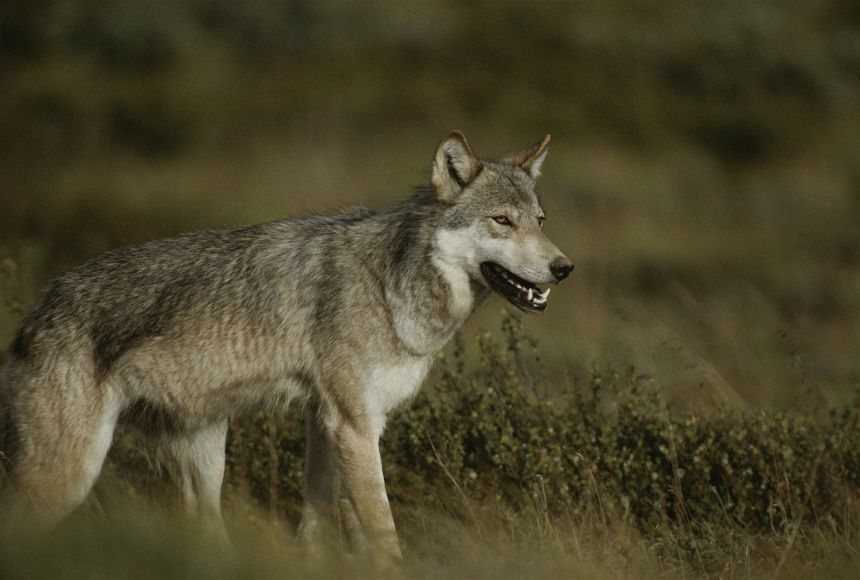
Gray Wolf in a Field
Reintroducing apex predators can have positive effects on the local ecosystem. The United States National Park Service reintroduced the gray wolf (Canis lupus) into Yellowstone National Park beginning in the mid-1990s.
Photograph by Michael S. Quinton
The booming fur trade of the 19th century catalyzed westward expansion and helped establish America as a rising force in the global economy. However, it also took a toll on wildlife; not only did it affect the animal populations coveted for their soft furs (for example, sea otters), but it also affected the broader food web. In the case of sea otters (Enhydra lutris), overhunting decimated the sea otter population, and the removal of this top predator from its environment had a negative effect that cascaded down throughout the ecosystem. Due to these lingering effects on the food web, sea otter populations have since had a hard time rebounding.
This is just one example of how a human-caused, near-extinction event has altered complex multiorganism dynamics connected with a top predator. In several ecosystems, overhunting has left once top predators unable to regain a foothold in their previous ecosystems.
The sea otter is an apex predator, a carnivore at the top of the localized food chain. The southern sea otter population off the California coast dropped from more than ten thousand in the 1700s to less than one hundred by the early 1900s. North American participation in the global fur trade heavily influenced this near-extinction. As U.S. society has evolved to prioritize species conservation efforts and regulate activities such as the harvesting of furs, people have gained interest in the preservation and reintroduction of once-hunted apex predators. However, the damage to the ecosystem has taken its toll.
The tendency of European immigrants to hunt animals to near extinction differed from that of many of the traditional practices of Indigenous North American peoples. They did not consider animals as inexhaustible resources. Because of this, when animals being hunted decreased, Native American tribes would move on to allow the animal population to rebound.
When the otter population dropped during the fur-trade era, it initiated a cascade of events that altered the region’s food web. Populations of sea urchins and other marine invertebrates, natural prey to sea otters, skyrocketed. This bloated population of invertebrates ate away whole forests of kelp to support themselves. The shrinking forests of algal seaweed forced fish, which used to find shelter within them, into alternate habitats. The absence of sea otters from the food web resulted in decreased ecosystem diversity. This type of relationship within a food web, in which the feeding habits of a predator trickle down and influence lower levels of the food web beyond the predator’s immediate prey, is called a trophic cascade.
A decline in the gray wolf (Canis lupus) population had a similar effect in the American northwest. In the 1900s, mostly European immigrants competed with wolves for large prey such as bison and deer, and hungry wolves inevitably instead preyed on livestock and were thus hunted themselves by ranchers protecting their flocks. The loss of gray wolves led to an explosion of the elk population and subsequent overgrazing of plants, including immature trees. This loss of vegetation negatively impacted beaver and bird populations. Without enough plants to hold the soil together or shade the ground, the overgrazing of the area also led to river bank erosion and changes in water temperature due to lack of shading.
There has been a recent legal fight about whether to keep grizzly bears (Ursus arctos horribilis) in the Yellowstone ecosystem on the endangered species list. Put on the list in 1975, the Yellowstone grizzlies were removed in 2007 and 2017, but they were reinstated soon after. The 2017 delisting was overturned by U.S. federal court in 2018 with the support of environmental and science organizations, and more than 120 Native American tribes, led by the Crow Indian Tribe. Many of these organizations are fighting the federal government’s removal of the bears from the endangered list in June 2025.
As scientists have learned more about trophic cascades, they have begun to discuss and implement efforts to reintroduce some top predators back into their ecosystems. For example, the National Park Service reintroduced wolves into Yellowstone National Park beginning in the mid-1990s, dramatically stabilizing some aspects of the food web and ecosystem. Repercussions included a decrease in the once overabundant elk population, a downstream increase in vegetation growth, and a rebound in the populations of smaller animals. It also affected mortality trends in the elk population. Now, young elk no longer die in bulk from starvation during winter. Instead, predation heavily influences mortality throughout the year.
However, the path back to a stable food web is not always the reverse of the environmental pathway that led to destabilization. This phenomenon, when the path to recovery differs from the path of disruption, is called hysteresis. In the case of the Yellowstone wolves, reintroduction has been largely successful and has reversed some of the ecological imbalance, but the balance within the food web may never return to its original stable state. In the case of the sea otter and other recent examples, reestablishment of the population and previous food web dynamics have been more complex.
In Central California, southern sea otter populations have rebounded to close to three thousand individuals (from less than one hundred a century ago). However, range expansion has not been as successful as repopulation, and some sources indicate that ecosystem changes are to blame. For example, during the long otter absence, sea urchins have consumed huge patches of kelp that once served as shelter for many animals. When modern otters venture into these now barren areas, sharks may easily spot them, leading to deadly encounters. However, the reintroduction of otters in the North Pacific near Alaska has shown similar success to that of the gray wolf in Yellowstone: Sea urchin numbers have decreased, kelp forests are beginning to expand, and marine biodiversity is increasing.
In other cases, reintroduction of predators has had less successful results. For example, wild dogs reintroduced to various parts of Africa, where they were once apex predators, failed to induce trophic cascades or improve ecosystem stability. More concerning, the reintroduction of the brown bear (Ursos arctos) population in the Pyrenees mountain range in Europe resulted in negative consequences—in particular, increased attacks on livestock, which cost local governments a great deal in compensation expenses. The Indian government reintroduced cheetahs in 2022, after being hunted to extinction there in 1952. It’s still too early to judge the success of this effort. Twenty cheetahs were brought from Namibia, and 32 having survived as of December 2025. These examples illustrate the complexity of trophic cascades and the often unpredictable ways in which predators affect their ecosystems and food web dynamics, tempering ideas about future opportunities to reintroduce predators to solve ecosystem problems.
Credits
Media Credits
The audio, illustrations, photos, and videos are credited beneath the media asset, except for promotional images, which generally link to another page that contains the media credit. The Rights Holder for media is the person or group credited.
Director
Author
Production Managers
Program Specialists
Producer
Intern
other
Last Updated
June 25, 2026
User Permissions
For information on user permissions, please read our Terms of Service. If you have questions about how to cite anything on our website in your project or classroom presentation, please contact your teacher. They will best know the preferred format. When you reach out to them, you will need the page title, URL, and the date you accessed the resource.
Media
If a media asset is downloadable, a download button appears in the corner of the media viewer. If no button appears, you cannot download or save the media.
Text
Text on this page is printable and can be used according to our Terms of Service.
Interactives
Any interactives on this page can only be played while you are visiting our website. You cannot download interactives.