ARTICLE
leveledARTICLE
The Role of Scavengers: Carcass Crunching
The Role of Scavengers: Carcass Crunching
Scavengers eliminate harmful substances from the environment, mitigating the spread of disease that may otherwise impact not only local food webs, but potentially human health and the economy.
Grades
3 - 12
Subjects
Biology, Ecology, Genetics, Health, Conservation
Image
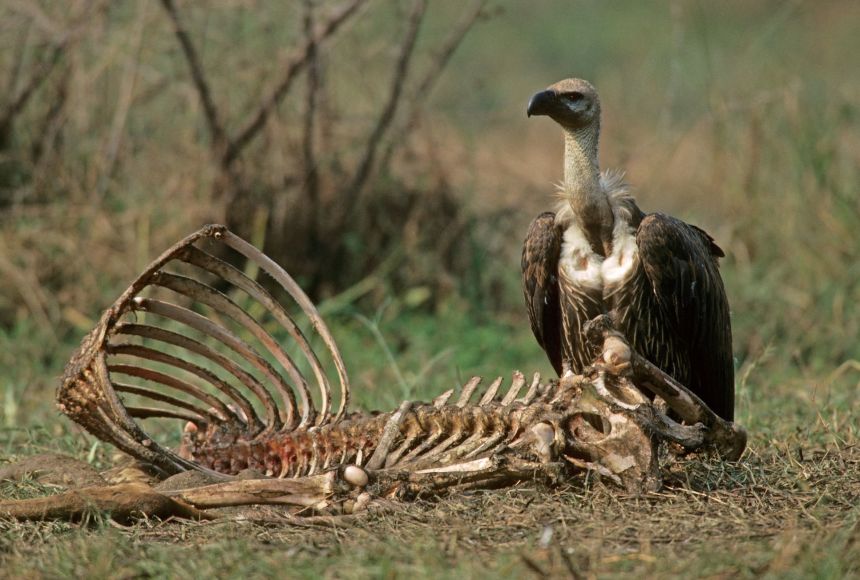
Vulture Feeding on Carcass
The cow medication diclofenac was banned in India because it poisoned and killed as many as 90 percent of that country's vultures. Here, a white-rumped vulture (Gyps bengalensis), which is an Indian vulture, feeds on a cow carcass.
Photograph by FLPA

When thinking about the beauty and balance of nature, scavengers may not be the first thing that comes to mind. However, the research community has become increasingly aware of the critical role scavenging plays in the stability of ecosystems and food webs. By consuming dead animals, called carrion, scavengers remove dead carcasses from the environment—a valuable service that goes well beyond environmental aesthetics.
For example, if left to thrive in a carcass, bacteria and other pathogens may spread within the local environment and infect other animals, including livestock and humans. Scavengers eliminate these harmful substances from the environment, mitigating the spread of disease that may otherwise impact local food webs and potentially harm human health and the economy.
Vultures, which exclusively eat dead animal carcasses, are particularly effective at removing pathogens and toxins in the environment because they rapidly consume carrion before it decays, and their stomachs contain an incredibly potent acid that destroys many of the harmful substances found in dead animals. Sadly, some toxins are still deadly to these scavengers, and such substances are responsible for the majority of vulture deaths over the last 40 years—a trend that has landed most vulture species on the endangered list.
What is poisoning vultures?
Vultures are present on five continents, and their well-being is threatened by toxins on at least three. Many vulture deaths stemming from toxins are preventable, and sometimes these deaths result from purposeful poisoning.
In the United States, the California condor population, a group of vultures whose wingspans can measure up to three meters (just inches short of 10 feet), was reduced to only 22 individuals in the 1980s because of accidental poisoning. The vultures fed on remnants of animals field-dressed by hunters (removing a killed animal's internal organs), and the carrion frequently contained bullet fragments, which were made from toxic lead that killed the avian consumers. Conservation efforts are under way and have been effective, but the California condor is still considered one of the rarest birds on Earth.
More recently, in the 1990s, widespread use of the cattle medication diclofenac dramatically reduced the vulture population in India. Because many birds can flock to and consume one cow carcass, each dead cow that had been recently treated with diclofenac could poison many vultures. Some studies estimated a decline in more than 90 percent of the Indian vulture population as a result of the use of this bovine veterinary drug. India has since banned diclofenac, but it is still legal in other countries—Spain, for example—where it may still threaten vultures.
Now, the African vulture population is on a decline, in part because of incidental toxin exposure, but also because of intentional poisoning. Herders poison carcasses to ward off predators such as lions, which pose a threat to livestock, but vultures are the more common victim. In more nefarious circumstances, poachers use these poisons on carcasses to purposefully target vultures so that they will not flock around the carcass of an illegally hunted animal. Other threats to the African vulture population include trade of vulture meat, use of vultures in medicine, and accidents involving power lines and wind turbines, an indicator that bird-friendly designs might be needed for implementation of renewable energy infrastructure in these areas.
National Geographic Explorer Darcy Ogada is involved in several conservation efforts related to vulture species in Africa. She has authored academic papers about the African vulture crisis that suggest governmental policy options for promoting vulture conservation efforts. Similarly, National Geographic Explorer Dr. Corinne Kendall is studying behavior patterns of healthy vulture populations in Tanzania to help better understand and protect vultures in all areas.
What are the consequences of the decline in the vulture population?
Vultures are not the only scavengers in nature, but they are often the dominant scavengers due to their ability to scan large areas from the air. As vulture populations decline, other scavengers (such as rats or dogs) can move in, which can throw off the ecosystem’s balance and be detrimental to wildlife, human health, and the economy.
For example, following the decline of the Indian vulture population, the population of feral dogs expanded rapidly—and with it, the incidence of rabies, an incredibly deadly disease. Approximately 50,000 people died from the pursuant rabies outbreak, and the associated public health costs were estimated at $34 billion. This sudden population shift can disrupt local food webs, and many of these scavengers that fill the vacated ecological niche are not as resistant to disease. They can carry disease back into the environment and towns, exposing people and other animals to pathogens. Carcasses can be infected with not only the rabies virus but also other bacteria, viruses, and toxins that are typically annihilated by a vulture's digestive systems. Without a healthy vulture population, the entire food web, and human populations, could be exposed to these pathogens and toxins.
These data and examples show that a single element in a larger food web plays a critical role in overall ecosystem health. The legacy of the vulture and its recent decline highlight threats to wildlife, human health, and the economy that may be present in other natural systems, were they to be disrupted. Fortunately, scientists learn more about our interconnected world each day, and individuals are working to prevent the extinction of animals like vultures.
Credits
Media Credits
The audio, illustrations, photos, and videos are credited beneath the media asset, except for promotional images, which generally link to another page that contains the media credit. The Rights Holder for media is the person or group credited.
Director
Author
Production Managers
Program Specialists
Producer
other
Last Updated
October 19, 2023
User Permissions
For information on user permissions, please read our Terms of Service. If you have questions about how to cite anything on our website in your project or classroom presentation, please contact your teacher. They will best know the preferred format. When you reach out to them, you will need the page title, URL, and the date you accessed the resource.
Media
If a media asset is downloadable, a download button appears in the corner of the media viewer. If no button appears, you cannot download or save the media.
Text
Text on this page is printable and can be used according to our Terms of Service.
Interactives
Any interactives on this page can only be played while you are visiting our website. You cannot download interactives.