ENCYCLOPEDIC ENTRY
ENCYCLOPEDIC ENTRY
Sedimentary Rocks
Sedimentary Rocks
Sedimentary rocks are one of three main types of rocks, along with igneous and metamorphic. They are formed on or near Earth’s surface from the compression of ocean sediments or other processes.
Grades
5 - 8
Subjects
Earth Science, Geology
Image
Sedimentary Rock
An example of a sedimentary rock, which is, by definition, composed of many, smaller rocks.
Photo courtesy of Alamy Stock Photo
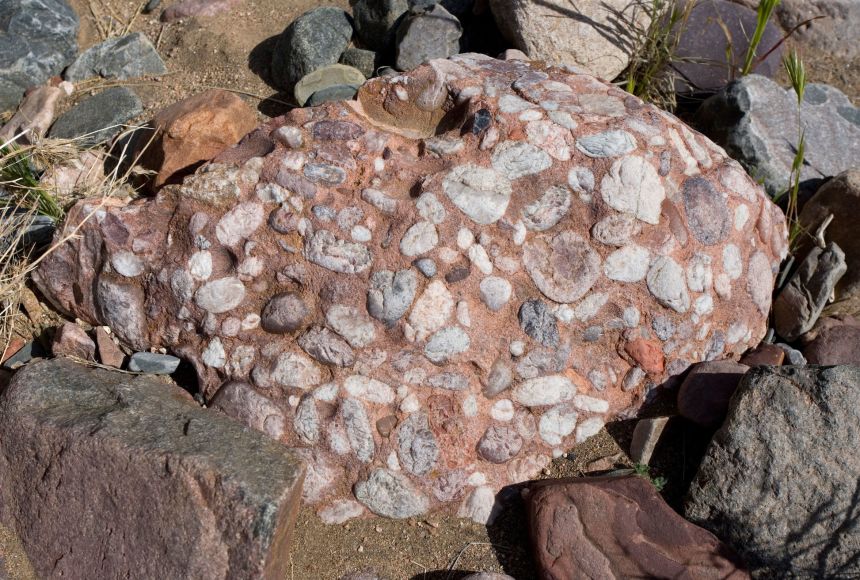
Sedimentary rocks are formed on or near Earth’s surface, in contrast to metamorphic and igneous rocks, which are formed deep within Earth. The most important geological processes that lead to the creation of sedimentary rocks are erosion, weathering, dissolution, precipitation and lithification.
Erosion and weathering include the effects of wind and rain, which slowly break down large rocks into smaller ones. Erosion and weathering transform boulders and even mountains into sediments, such as sand or mud. Dissolution is a form of weathering—chemical weathering. With this process, water that is slightly acidic slowly wears away stone. These three processes create the raw materials for new, sedimentary rocks.
Precipitation and lithification are processes that build new rocks or minerals. Precipitation is the formation of rocks and minerals from chemicals that precipitate from water. For example, as a lake dries up over many thousands of years, it leaves behind mineral deposits; this is what happened in Death Valley, located in the U.S. state of California. Finally, lithification is the process by which clay, sand and other sediments on the bottom of the ocean or other bodies of water are slowly compacted into rocks from the weight of overlying sediments.
Sedimentary rocks can be organized into two categories. The first is detrital rock, which comes from the erosion and accumulation of rock fragments, sediment or other materials—categorized in total as detritus, or debris. The other is chemical rock, produced from the dissolution and precipitation of minerals.
Detritus can be organic or inorganic. Organic detrital rocks form when parts of plants and animals decay in the ground, leaving behind biological material that is compressed and becomes rock. Coal is a sedimentary rock formed over millions of years from compressed plants. Inorganic detrital rocks, on the other hand, are formed from broken up pieces of other rocks, not from living things. These rocks are often called clastic sedimentary rocks. One of the best-known clastic sedimentary rocks is sandstone. Sandstone is formed from layers of sandy sediment that is compacted and lithified.
Chemical sedimentary rocks can be found in many places, from the ocean to deserts to caves. For instance, most limestone forms at the bottom of the ocean from the precipitation of calcium carbonate and the remains of marine animals with shells. If limestone is found on land, it can be assumed that the area used to be under water. Cave formations are also sedimentary rocks, but they are produced very differently. Stalagmites and stalactites form when water passes through bedrock and picks up calcium and carbonate ions. When the chemical-rich water makes its way into a cave, the water evaporates and leaves behind calcium carbonate on the ceiling, forming a stalactite, or on the floor of the cave, creating a stalagmite.
Credits
Media Credits
The audio, illustrations, photos, and videos are credited beneath the media asset, except for promotional images, which generally link to another page that contains the media credit. The Rights Holder for media is the person or group credited.
Director
Author
Production Managers
Program Specialists
Producer
Intern
other
Last Updated
August 11, 2026
User Permissions
For information on user permissions, please read our Terms of Service. If you have questions about how to cite anything on our website in your project or classroom presentation, please contact your teacher. They will best know the preferred format. When you reach out to them, you will need the page title, URL, and the date you accessed the resource.
Media
If a media asset is downloadable, a download button appears in the corner of the media viewer. If no button appears, you cannot download or save the media.
Text
Text on this page is printable and can be used according to our Terms of Service.
Interactives
Any interactives on this page can only be played while you are visiting our website. You cannot download interactives.