IDEA SET
IDEA SET
SIMOC
SIMOC
Explore the challenges of living on Mars! Living off-world, far
from home is not as easy as science fiction makes it seem. It takes
a careful balance of food rations, air and water recycling,
greenhouse agriculture, and solar energy production to keep this
ecosystem running.
Grades
5 - 12+
Subjects
Biology, Earth Science, Astronomy, Engineering

Loading ...
With this interactive simulator built on authentic NASA research
and data, you design your mission, set it in motion, and learn if
you will need more than potatoes to survive! Use this simulation
with the included, freely available, NGSS aligned curriculum to
guide your students through the design of an off-world habitat and
how living on Mars demonstrates improved living on Earth today.
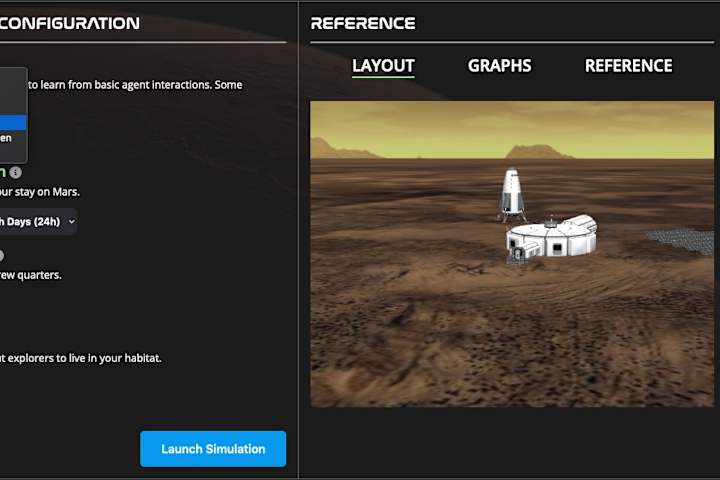
SIMOC
Could you survive on Mars? Use the SIMOC configuration panels to design your habitat. It's a challenging endeavor with myriad solutions. Students are engaged in iterative, scientific research built on authentic human factors and plant study data at NASA.
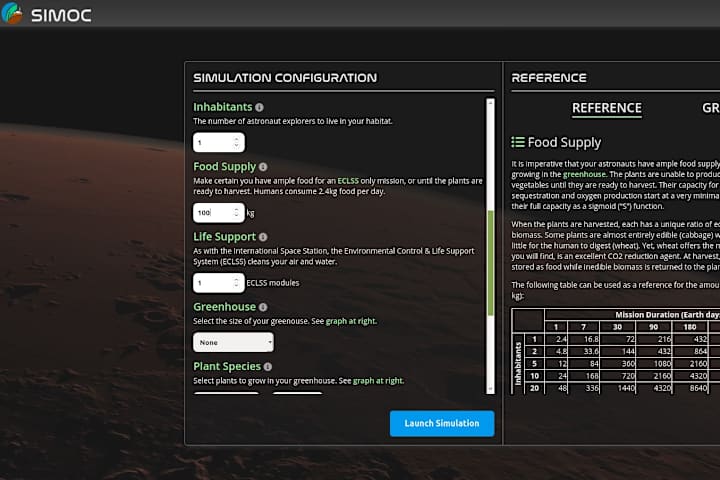
Habitat Design: Food
Will your astronauts rely entirely on freeze-dried food rations or transition to fresh fruits and vegetables grown in your Mars greenhouse? Students are asked to consider the careful balance of a closed ecosystem, at all scales.
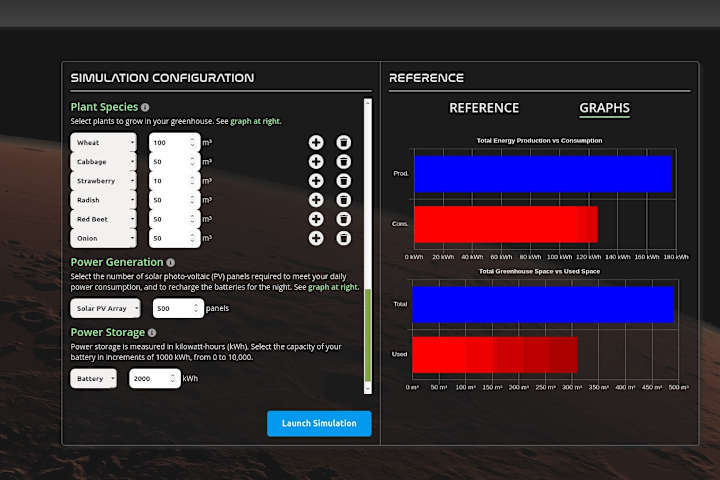
Habitat Design: Greenhouse
The types and quantities of plants you select directly affects your survival on Mars. Too few plants and you run out of food. Too many and your astronauts won't produce enough CO2 to support the plants. Humans need plants, and the plants need humans too!
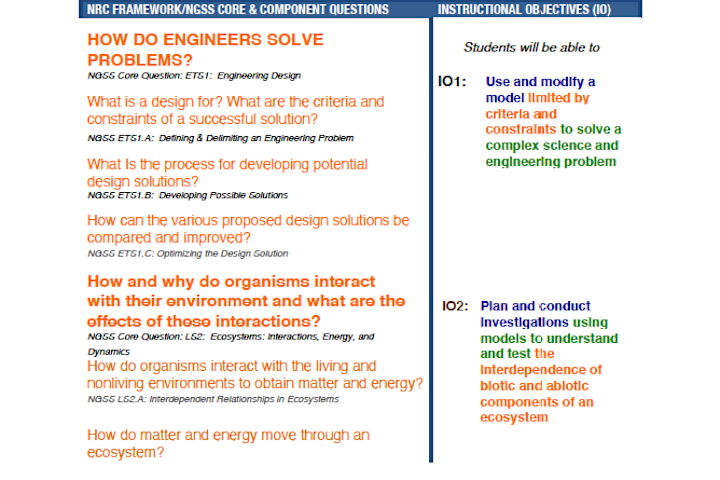
SIMOC 9-14 Alignment
Written by a veteran NASA curricula developer, the engaging SIMOC lessons are aligned with the Next Generation Science Standards (NGSS), Common Core State Standards, and 21st Century Skills.
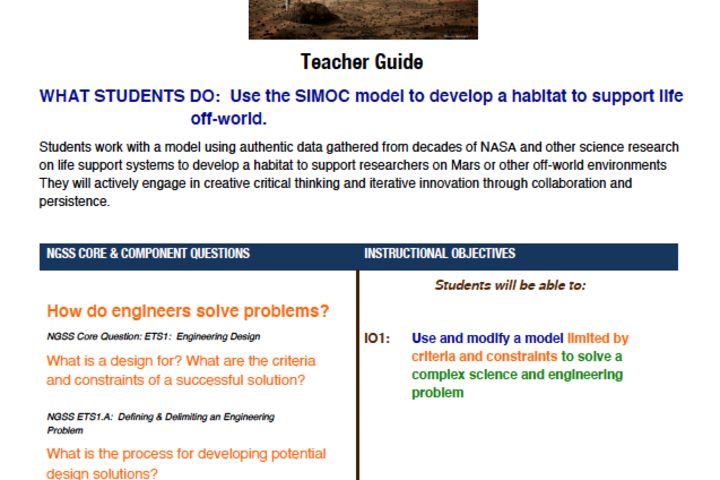
SIMOC Lesson Grades 9-14
Each simulation generates a rich dataset available for download. Students can use spreadsheets, graphs, and machine learning to investigate the dynamical interactions between the many agents in this hi-fidelity simulation.
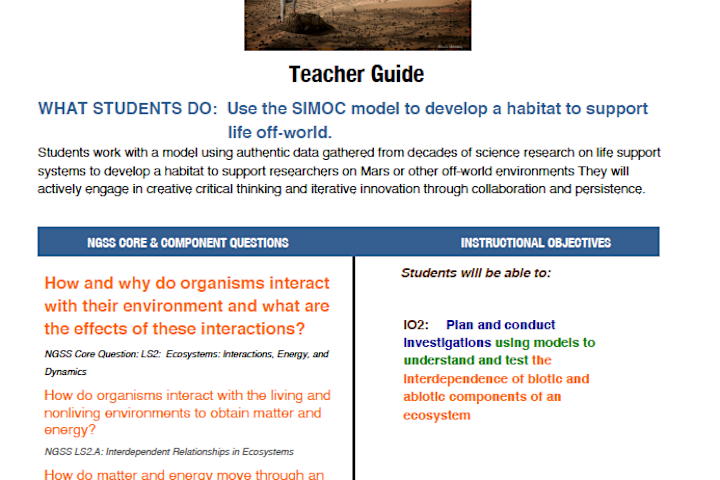
SIMOC Lesson Grades 5-8
Use SIMOC in your middle school classroom! These documents guide teachers and students through the iterative application of the scientific method. Learn how to build a model, test, review the outcome, and update your hypothesis — while living on Mars!
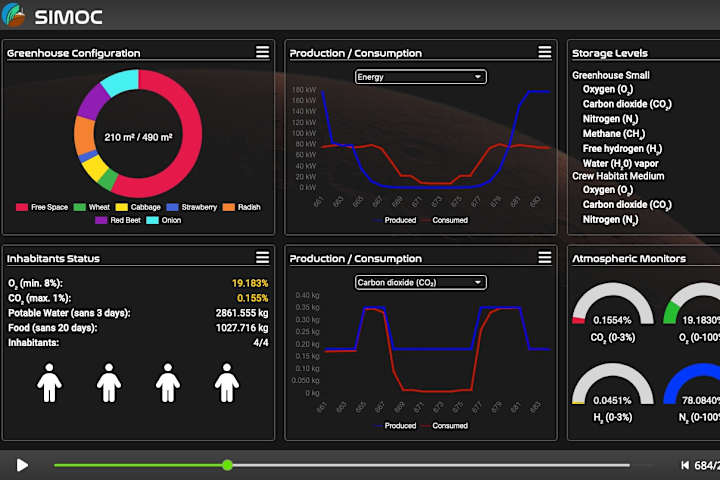
Interactive
In the coming decades, we will establish ourselves in orbit around the moon, on the surface of Mars and in a more distant future on moons of Jupiter and Saturn. To get there we must learn how to sustain human life in hostile environments, with limited resupply.
SIMOC [see-mok] is a scalable, interactive model of an off-world community. The model is founded on published data derived from life support and closed ecosystem research at NASA and universities world-wide. The users are invited to design a habitat that sustains human life through a combination of physico-chemical (mechanical) and bioregenerative (living plant) systems, selecting various combinations of crew quarters, greenhouse, food and plants, energy generation and storage, and mission duration.
Sound simple? Science fiction has made it look too easy with airlocks that never require decompression, food materializing out of thin air, and the processing of waste or recycling of air something that happens off-camera. In the real cosmos, living off-world is far more challenging. Finding a balance of machines, plants and humans is a complex endeavor. The slightest incongruity in waste management, power production, or carbon dioxide scrubbing can result in catastrophic failure, forcing the abandonment of the habitat, or worse.
After 50 years in low-Earth orbit, solutions for living in space remain heavily biased toward mechanical systems and resupply missions. This is not a long-term solution if we desire to establish new homes among the stars. SIMOC is a place to experiment, to test theories, and make mistakes — to explore.
The SIMOC team has developed free curricula for grades 5-8 and 9-14, with guidance for both teachers and students. These classroom lessons are aligned with Next Generation Science Standards (NGSS), Common Core State Standards, and 21st Century Skills. Give the lessons a try and help build a future for off-world communities throughout the solar system, as well as a greater understanding of our first spaceship — Earth.
If you are new to SIMOC, we encourage you to read the First Time User page at SIMOC.space where you will also find a wealth of information, resources, and educational guidelines.
Credits
Media Credits
The audio, illustrations, photos, and videos are credited beneath the media asset, except for promotional images, which generally link to another page that contains the media credit. The Rights Holder for media is the person or group credited.
Project Lead
Lead Server Developer
Lead Front-End Developer
Assistant Developer
Habitat Architect and 3D Artist
ASU Associate Lead
Educational Lead
Director
Producer
other
Last Updated
July 28, 2026
User Permissions
For information on user permissions, please read our Terms of Service. If you have questions about how to cite anything on our website in your project or classroom presentation, please contact your teacher. They will best know the preferred format. When you reach out to them, you will need the page title, URL, and the date you accessed the resource.
Media
If a media asset is downloadable, a download button appears in the corner of the media viewer. If no button appears, you cannot download or save the media.
Text
Text on this page is printable and can be used according to our Terms of Service.
Interactives
Any interactives on this page can only be played while you are visiting our website. You cannot download interactives.