ENCYCLOPEDIC ENTRY
ENCYCLOPEDIC ENTRY
Smokejumper
Smokejumper
Smokejumpers are skydiving firefighters. They are the first ones on the scene when wildfires break out in remote areas.
Grades
5 - 8
Subjects
Conservation, Engineering, Social Studies, U.S. History
Image
Smokejumper Training
Smokejumpers are firefighters who parachute into hard-to-reach areas to fight fires. The smokejumper shown here is taking part in a training operation.
Photograph by J. Baylor Roberts
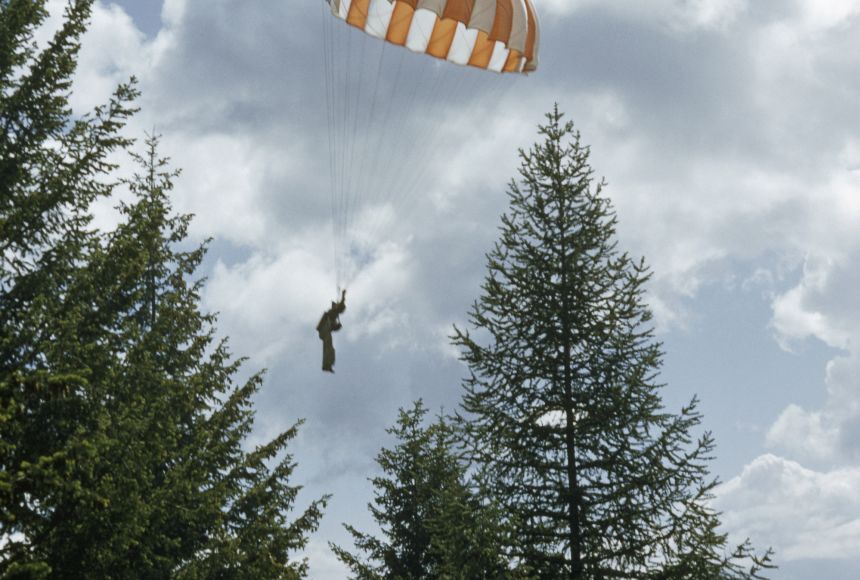
Smokejumpers are skydiving firefighters. When lightning (or a careless camper) sparks a wildfire in a remote, roadless place, smokejumpers parachute in as the first line of defense to fight the fire.
A Crazy Idea Takes Flight
T. V. Pearson, a United States Forest Service employee, was the first to suggest that firefighters could parachute in to attack remote wildfires back in 1934. After tests showed smokejumpers could make a difference, the first official jump on an active fire took place in 1940.
Today, the U.S. Forest Service has seven smokejumping crews stationed in the western states where wildfires most often occur. The U.S. Bureau of Land Management has two additional crews in Idaho and Alaska. If the risk of fire is high in a certain location, smokejumpers may relocate to a temporary “spike base,” which is closer to the high-risk area—that way, they can get there fast if fire breaks out.
In all, about 400 smokejumpers work for the U.S. government. A few other nations with expansive forests, like Russia, also have smokejumping programs.
It Takes Training
To get hired as a smokejumper, one must already have experience fighting wildfires on the ground. Rookies need to already know how to use wildfire-fighting tools, be in peak physical condition, and be able to stay calm under severe stress.
During spring training, smokejumpers undertake physical conditioning and must pass a fitness test. One important requirement: smokejumpers must be able carry a 50-kilogram (110-pound) pack for 4.8 kilometers (three miles) in 90 minutes or less.
There is also jump training, which includes practicing safe landings and learning about parachute maneuvering. To practice parachuting skills, smokejumpers spend time in a landing simulator nicknamed the “Mutilator” that drops them (on a cable) from high in the air, so they can learn how to drop, roll, and get up unhurt.
Smokejumpers also learn about emergency medical care and become expert tailors, since they are responsible for maintaining their own parachutes, gear bags, and jumpsuits.
Boots on the Ground
When the siren sounds, smokejumpers gather their gear and jump on a plane. A designated “spotter” (a highly experienced smokejumper) scans the ground to find a safe place to drop.
After the smokejumping team lands near the fire, the crew in the aircraft above them drops supplies that also float down by parachute. Besides firefighting tools, smokejumpers need food, water, and other supplies so they can work without further support for up to three days.
To stop a fire when there are no fire hydrants or firetrucks to supply water, smokejumpers create a “firebreak”—a zone that interrupts the fire’s fuel source—by felling trees, cutting brush, and digging long trenches in the ground ahead of the direction the fire is traveling. The smokejumper slang for this process is “punching line.” This process stops the fire in its tracks, preventing it from spreading and causing more damage.
Credits
Media Credits
The audio, illustrations, photos, and videos are credited beneath the media asset, except for promotional images, which generally link to another page that contains the media credit. The Rights Holder for media is the person or group credited.
Director
Author
Production Managers
Program Specialists
Producer
Intern
other
Last Updated
July 30, 2026
User Permissions
For information on user permissions, please read our Terms of Service. If you have questions about how to cite anything on our website in your project or classroom presentation, please contact your teacher. They will best know the preferred format. When you reach out to them, you will need the page title, URL, and the date you accessed the resource.
Media
If a media asset is downloadable, a download button appears in the corner of the media viewer. If no button appears, you cannot download or save the media.
Text
Text on this page is printable and can be used according to our Terms of Service.
Interactives
Any interactives on this page can only be played while you are visiting our website. You cannot download interactives.