ENCYCLOPEDIC ENTRY
ENCYCLOPEDIC ENTRY
Southeast Native American Groups
Southeast Native American Groups
Native Americans called the land of the Southeast their home for thousands of years before European colonization. The settlement of the Carolinas brought about a drastic change to their lives.
Grades
5 - 12
Image
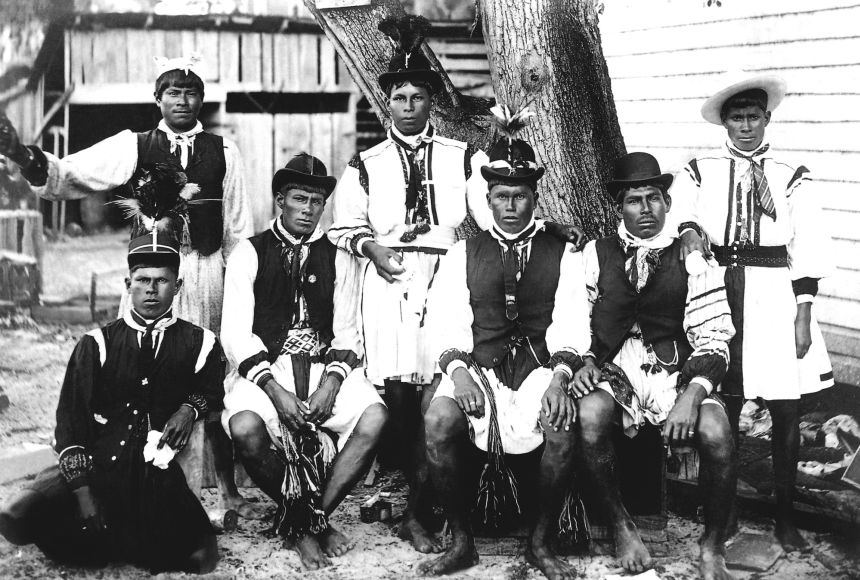
Seminole Braves
The Seminole (like this group of Seminole Braves) were among the southeastern nations called the "Five Civilized Tribes" by European settlers. These nations were considered such because of their adoption of European cultural traits.
Photograph by Buyenlarge
The land along the Atlantic Coast was inhabited long before the first English settlers set foot in North America. There were more than two dozen Native American groups living in the Southeast region, loosely defined as spreading from North Carolina to the Gulf of Mexico. These groups included the Chickasaw (CHIK-uh-saw), Choctaw (CHAWK-taw), Creek (CREEK), Cherokee (CHAIR-oh-kee), and Seminole (SHE-min-ol). Today, Indigenous people in the Americas have different preferences about what they want to be called. “Native American” and “Indigenous American” are both acceptable terms, but it’s best to use specific tribal nation names whenever possible.
By the time of European contact, most of these Native American groups had settled in villages of five hundred people or fewer, and they grew corn, beans, squash, sunflowers, greens, tobacco and other crops. The Southeast Native Americans also gathered berries, nuts and wild plants and roots from the surrounding forests. For the most part, women tended the fields, while men hunted, fished and engaged in trade with one another, as well as with other groups to the north and west. Though their tasks were different, the roles of men and women were considered equally important, and their societies had a high degree of egalitarianism. Some groups in the Southeast were women-centered and matrilineal, meaning the children inherited their family lineage from their mothers. The nations also had rich cultural touchstones, creating complex hierarchies of power based on both law and religion. Their ingenuity was evident; they readily adapted to their changing environment, particularly as their way of life was threatened. Bands of Cherokee, for example, developed their own syllabary and adopted a written constitution to become a strong political state in the face of the growing threat of European expansion.
Life for the southeastern groups, as for Native Americans throughout the Americas, changed with European exploration and colonization. Native Americans had no immunity to smallpox or other European diseases, and the spread of these diseases killed thousands of Indigenous people. Others were killed or enslaved by the Spanish colonizers who led the 16th-century expeditions through the Southeast. These factors weakened the remaining groups. Many joined with larger or stronger groups, such as the Cherokee and the Creek.
With colonization came a desire to convert Native Americans to Christianity and to encourage (or force) them to adopt European cultures and traditions. These efforts were more successful in the Southeast than most parts of North America; indeed, five southeastern nations (the Creek, Cherokee, Choctaw, Chickasaw and Seminole) later became known as the “Five Civilized Tribes.” This name was given to them by white Americans because they outwardly adopted Christianity and European customs that were vastly different from their own highly developed Indigenous cultural practices. As a result of this assimilation, women in many matriarchal societies lost their status and power. Additionally, Europeans still viewed even the most “civilized” groups as inferior, and waves of immigrants encroached on the Native Americans’ land. The southeastern groups signed treaties to cede land to the colonies and moved, only to be followed by new settlers looking for new land. Conflicts between Native Americans and white settlers often erupted into violence. The southeastern Native Americans could not defend themselves against the colonists’ seemingly never-ending demand for land. Like other Native Americans, they were pushed farther west and onto reservation land.
After the United States was founded, the U.S. government engaged in a persistent effort to rid the Southeast of the Indigenous people who lived there. In 1830, Congress passed the Indian Removal Act, giving the federal government the power to force Native American tribes living in the southeastern United States to move to land west of the Mississippi River. In the Seminole Wars of the early 1800s, the Seminoles lost their ongoing efforts to hold onto their land and were forced west. The Cherokee fought for their land in court. Despite winning a Supreme Court case, they too were forcibly removed from their land. The U.S. Army forced many Native Americans to travel thousands of miles from their land in the Southeast to present-day Oklahoma, with much of the journey made on foot. Thousands of people died along the way, giving rise to the moniker “Trail of Tears.”
Today, the Indigenous nations of the southeastern United States continue to thrive and assert their sovereignty. Some bands of Cherokee successfully evaded forced removal by fleeing to the Smoky Mountains, where their descendants continue to reside today. Others overcame the harsh conditions to establish new lives in and beyond present-day Oklahoma. These nations continue to advocate for their sovereignty and rights, preserve their traditions and practice their cultures today.
Credits
Media Credits
The audio, illustrations, photos, and videos are credited beneath the media asset, except for promotional images, which generally link to another page that contains the media credit. The Rights Holder for media is the person or group credited.
Director
Author
Production Managers
Program Specialists
Producer
Intern
other
Last Updated
July 10, 2026
User Permissions
For information on user permissions, please read our Terms of Service. If you have questions about how to cite anything on our website in your project or classroom presentation, please contact your teacher. They will best know the preferred format. When you reach out to them, you will need the page title, URL, and the date you accessed the resource.
Media
If a media asset is downloadable, a download button appears in the corner of the media viewer. If no button appears, you cannot download or save the media.
Text
Text on this page is printable and can be used according to our Terms of Service.
Interactives
Any interactives on this page can only be played while you are visiting our website. You cannot download interactives.