ENCYCLOPEDIC ENTRY
ENCYCLOPEDIC ENTRY
Stream
Stream
Streams are flowing bodies of water that provide benefits to humans and are important habitats to plants and animals.
Grades
5 - 8
Image
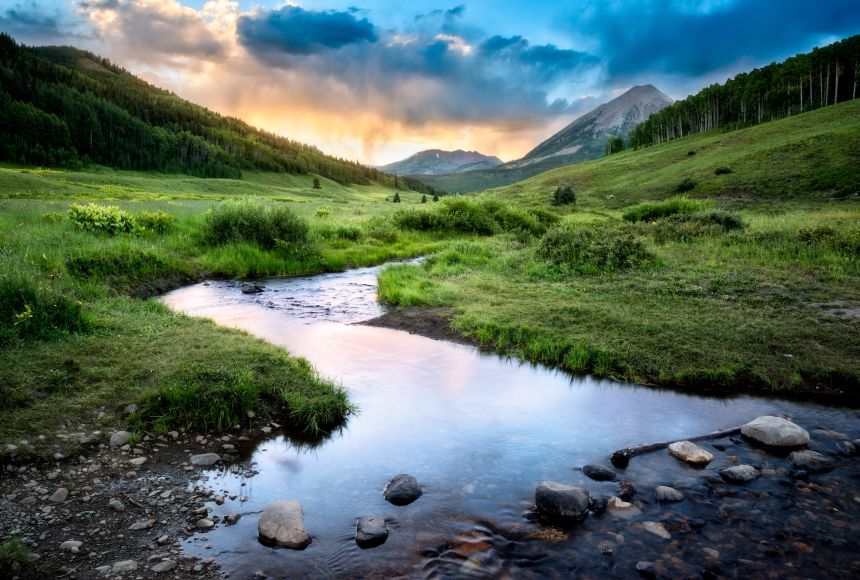
Stream in Colorado
This stream in Crested Butte, Colorado, United States is an important water source for many humans and animals.
Photograph by Adam Springer
A stream is a body of water that flows on Earth’s surface. The word stream is often used interchangeably with river, though rivers usually describe larger streams.
Streams provide many benefits to humans. Besides providing drinking water and irrigation for crops, streams wash away waste and can provide electricity through hydropower. People often use streams recreationally for activities such as swimming, fishing, and boating. Streams also provide important habitat for wildlife.
Streams need two things to exist: gravity and water. When precipitation falls onto the ground, some water trickles into groundwater, but much of it flows downhill across the surface as runoff and collects into streams. A watershed, or drainage basin, is the area that collects water for a stream. As smaller streams flow downhill, they often merge together to form larger streams. These smaller streams are called tributaries.
Streams create channels by wearing down rock and carrying it and other sediment downstream. This process is called erosion. The forces that make backyard gullies are the same as those that carved out the Grand Canyon.
Depending on the landscape they flow through, streams have different shapes. Meandering streams have one channel that snakes across the landscape. Over time, these curves can become so wide that they meet and cut off the bend from the rest of the stream, creating oxbow lakes. Braided rivers have many channels that separate and merge like a braid of hair. Planetary scientists have found formations that look like stream channels on the surface of Mars, suggesting water flowed there in streams at one point in the planet’s history.
Streams provide an important ecosystem for many plants and animals, including fish, birds, salamanders, snails, and mammals. Different plants and animals have evolved to thrive in streams. Plants often have strong root systems that act as anchors, and long, flexible stems that can move with the current. Fly larvae nibble on leaves that have fallen into the water, and the flies themselves later become fish food. Mussels bury into sediment on the stream’s floor, to stay in place as they filter the water for food. Many fish have streamlined shapes that help them stay in position and keep them from being washed away by strong currents.
Many factors can harm a stream’s health. Dams stop the natural flow of sediment and water, and prevent wildlife, nutrients, and water from flowing freely through the stream system. Urban areas sometimes flush untreated sewage into streams, causing algal blooms that suffocate wildlife. Pollutants can wash into streams from farms and factories, and harm wildlife and humans who depend on the water.
In response to these threats, scientists and conservationists are taking action. Hydrologists study streams and how water quality and flow change over time. Conservationists can work with communities to revive stream basins. Osvel Hinojosa Huerta is a National Geographic Explorer who worked to improve the Colorado River ecosystem in the United States and Mexico. Sandra Postel, a past National Geographic Freshwater Fellow, created a program that restored billions of gallons of water to river systems in North America.
Credits
Media Credits
The audio, illustrations, photos, and videos are credited beneath the media asset, except for promotional images, which generally link to another page that contains the media credit. The Rights Holder for media is the person or group credited.
Director
Author
Production Manager
Program Specialists
Specialist, Content Production
Producer
other
Last Updated
October 19, 2023
User Permissions
For information on user permissions, please read our Terms of Service. If you have questions about how to cite anything on our website in your project or classroom presentation, please contact your teacher. They will best know the preferred format. When you reach out to them, you will need the page title, URL, and the date you accessed the resource.
Media
If a media asset is downloadable, a download button appears in the corner of the media viewer. If no button appears, you cannot download or save the media.
Text
Text on this page is printable and can be used according to our Terms of Service.
Interactives
Any interactives on this page can only be played while you are visiting our website. You cannot download interactives.