ARTICLE
ARTICLE
Sumatran Rhinoceros
Sumatran Rhinoceros
Grades
5 - 8
Subjects
Biology, Ecology, Conservation
Image
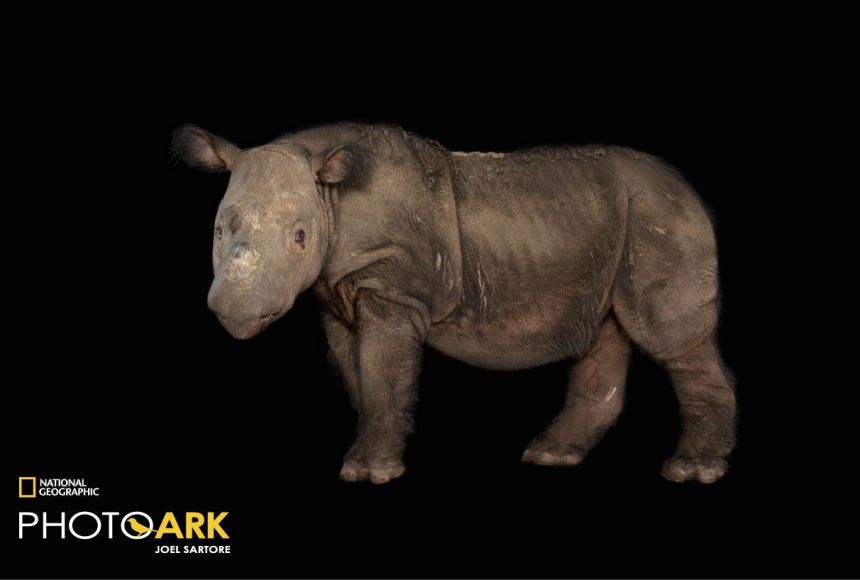
Sumatran Rhino
A Sumatran rhino (Dicerorhinus sumatrensis) poses for a picture at the White Oak conservation center in Yulee, Florida.
Joel Sartore/National Geographic Photo Ark
About the Sumatran Rhinoceros
The two-horned Sumatran rhinoceros (Dicerorhinus sumatrensis) shares the bleak distinction of world’s most endangered rhino with its regional cousin, the Javan rhino. The smallest of the rhino family, the Sumatran rhinoceros lives in isolated pockets in the dense mountain forests of Indonesia.
Diet
Sumatran rhinos are generally solitary creatures that feed on fruits, twigs, leaves, and shrubs. Like other rhinos they have a keen sense of smell and sharp hearing, and they use these traits to distinguish their territories from rival rhinos.
Size and Hairy Hide
As the smallest rhino, they weigh about 798 kilograms (1,760 pounds), and grow to a height near 1.5 meters (5 feet) at the shoulders and 2.45 to 3.05 meters (8 to 10 feet) in length. Unlike most other rhinos, their hide, dark red-brown in color, is covered with patches of short, dark, stiff hair.
Rhino Horn and Trafficking
The Sumatran rhino’s two horns are considerably smaller than those of their African relatives, the black and white rhinos. The anterior horn may grow up to 79 centimeters (31 inches), but is normally much smaller, while the posterior horn may grow up to 7.5 centimeters (3 inches), but is generally no more than a hump.
The horns for which rhinos are so well known have been their downfall. Many animals have been killed for this hard growth, which is made of a hair-like substance and is revered for medicinal use in China, Taiwan, Hong Kong, and Singapore. The horn is also valued in the Middle East, Yemen especially, and North Africa as an ornamental dagger handle.
Conservation
Listed as critically endangered, there are thought to be fewer than 100 Sumatran rhinos in existence today. While a number of these animals are kept in zoos, they rarely breed in captivity. The main threats to their survival in the wild include poaching and habitat encroachment by humans.
Credits
Media Credits
The audio, illustrations, photos, and videos are credited beneath the media asset, except for promotional images, which generally link to another page that contains the media credit. The Rights Holder for media is the person or group credited.
Director
Author
Production Managers
Program Specialists
Specialist, Content Production
Producer
other
Last Updated
October 19, 2023
User Permissions
For information on user permissions, please read our Terms of Service. If you have questions about how to cite anything on our website in your project or classroom presentation, please contact your teacher. They will best know the preferred format. When you reach out to them, you will need the page title, URL, and the date you accessed the resource.
Media
If a media asset is downloadable, a download button appears in the corner of the media viewer. If no button appears, you cannot download or save the media.
Text
Text on this page is printable and can be used according to our Terms of Service.
Interactives
Any interactives on this page can only be played while you are visiting our website. You cannot download interactives.