ENCYCLOPEDIC ENTRY
ENCYCLOPEDIC ENTRY
Territory
Territory
Territory is a geographical area subject to the sovereignty, control, or jurisdiction of a state or other entity.
Grades
5 - 8
Subjects
Geography, Human Geography, Social Studies
Image
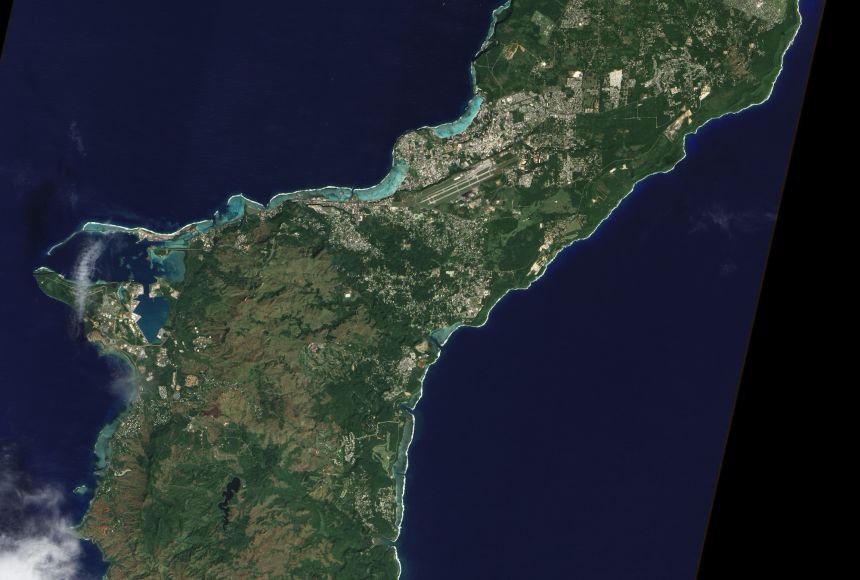
Guam Satellite Image
Guam is an example of an occupied territory. The United States government occupies the South Pacific island. The distance between Guam and the nearest U.S. state, Hawai'i, is more than 6,000 kilometers (3,728.23 miles).
Image created by Jesse Allen and Robert Simmon, using U.S. NASA Earth Observatory (EO)-1 data courtesy of the NASA EO-1 team and the United States Geological Survey
Broadly speaking, for purposes of international law, a territory is a geographical area subject to the sovereignty, control, or jurisdiction of a state or other entity.
In addition to land, territory includes adjacent waters and associated airspace. A state’s territorial sea, where it is sovereign, extends 19 kilometers (12 miles) into the sea. Another 19 kilometers (12 miles) out comprises a contiguous zone for sovereign states, in which some control can be exercised (usually police and public-safety functions). Nations may also exercise an exclusive economic zone out to 322 kilometers (200 miles) where they may develop natural resources.
Under international law, a territory is an essential part of the definition of a state. In 1933, a convention took place among many of the nations of the Americas in Montevideo, Uruguay. The convention established international norms for recognizing sovereignty, boundaries, and international relations. Article 1 of the 1933 Montevideo Convention states that a “state as a person of international law should possess the following qualifications: a) a permanent population; b) a defined territory; c) a government; and d) capacity to enter into relations with the other states.”
Article 11 of the Montevideo Convention further provides that states are not to recognize territorial acquisitions that have been obtained by force. Moreover, the territory of a state is unbreakable and may not be the object of military occupation or other measure of force. The United Nations (UN) Charter likewise provides that member states must keep from using force—or even the threat of force—against the territorial integrity of any state.
However, territory and sovereignty over territory may be acquired by other means. According to international law, these have included occupation, prescription, accretion, cession, and, possibly, annexation.
Occupation occurs when control is acquired over an otherwise uncontrolled territory by a foreign state. Typically, this must be peaceful and public.
Prescription is similar to occupation, but concerns otherwise empty territory. If a second state occupies that territory peacefully and publicly over a long period of time, it may be said to have acquired the territory.
Accretion is when a state's territory increases by natural processes, such as deposits from rivers or volcanic eruptions.
Cession is when one nation voluntarily gives up territory to another, typically via a treaty or sale. The cession may be the result of a dispute or conflict settlement. Examples from the United States, include the Louisiana Purchase from France and the Gadsden Purchase from Mexico.
Annexation implies the taking of land, frequently associated with at least some degree of coercion. Examples include the U.S. annexation of Texas in 1845, and Germany’s annexation of Austria in 1938. Although condemned by the UN Charter, annexation by force, or conquest, may be recognized by other states over time.
Credits
Media Credits
The audio, illustrations, photos, and videos are credited beneath the media asset, except for promotional images, which generally link to another page that contains the media credit. The Rights Holder for media is the person or group credited.
Director
Author
Production Managers
Program Specialists
Producer
Intern
other
Last Updated
July 30, 2026
User Permissions
For information on user permissions, please read our Terms of Service. If you have questions about how to cite anything on our website in your project or classroom presentation, please contact your teacher. They will best know the preferred format. When you reach out to them, you will need the page title, URL, and the date you accessed the resource.
Media
If a media asset is downloadable, a download button appears in the corner of the media viewer. If no button appears, you cannot download or save the media.
Text
Text on this page is printable and can be used according to our Terms of Service.
Interactives
Any interactives on this page can only be played while you are visiting our website. You cannot download interactives.