ARTICLE
leveledARTICLE
In Their Footsteps: Human Migration Out of Africa
In Their Footsteps: Human Migration Out of Africa
Paul Salopek is an award-winning journalist and National Geographic Explorer, who is following the footsteps of our ancestors out of Africa. As he walks, Salopek is documenting the places he travels, the people he meets, and telling the stories of our human history, from the very earliest humans to our more recent past.
Grades
4 - 12
Subjects
Anthropology, Archaeology, Geography, Human Geography, Social Studies, World History
Image
Salopek and Hessan
Picture of Paul Salopek and guide Ahmed Alema Hessan outside of Bouri
Photograph by John Stanmeyer/National Geographic
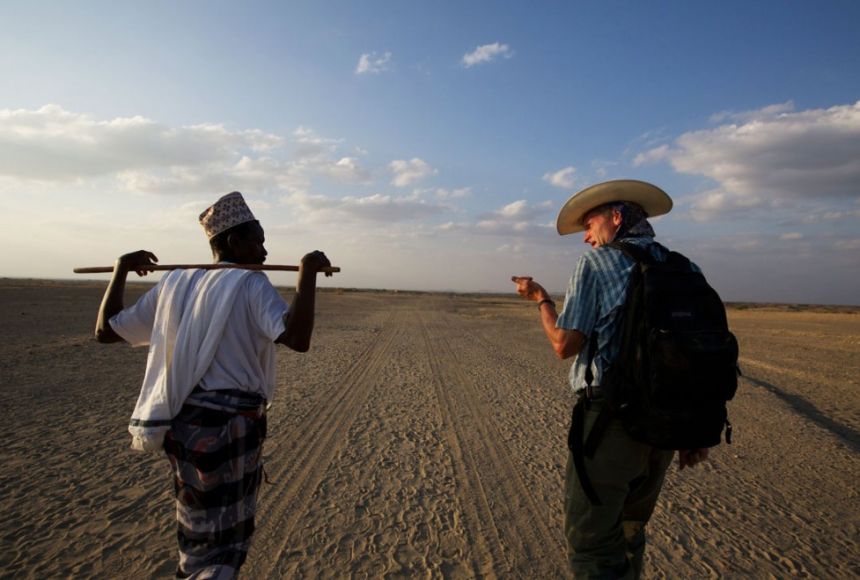

Paul Salopek is an award-winning journalist and National Geographic Explorer. He is also a walker. And he is on a very long walk. One that will last at least 10 years. One some of our human ancestors took about 60,000 years ago, by some estimates.
In 2013, Paul Salopek set out to walk the path some of our ancestors walked when they migrated out of Africa. He has named his expedition the Out of Eden Walk. His route will take him from Ethiopia to the Middle East, through Central and Southeast Asia, and across China. The land bridge our ancestors used to cross from Asia to North America has long since disappeared. So Salopek will take a ship across the Pacific Ocean. He will then walk through the West Coast of the United States and Mexico. He will cross Central America to South America and walk along its western coast to Tierra del Fuego—the southernmost tip of the continent. Just as some of our ancestors did, Salopek will travel mostly along the outside edges of the continents, near oceans, and seas.
As he walks, Salopek is documenting the places he travels and the people he meets. Salopek is also telling the stories of our human history, from the earliest humans to our more recent past. Some of the places he has walked through have clues that can help us understand early humans and our even-earlier hominin ancestors.
In the Beginning
Salopek chose Herto Bouri, Ethiopia, for the starting point of the Out of Eden Walk. This desert site is a good place to start retracing the steps of early humans. It is the location of the 160,000-year-old Herto man fossil. Herto man is thought by many scientists to be the oldest fully recognizable, modern human ever found. It is one of the paths believed to have been taken by some of our early ancestors from Africa to Europe and Asia. Fossil evidence shows that these early humans made crude stone tools. They also possibly had rituals for their dead.
Herto man is proof that modern humans (Homo sapiens) lived in Africa at least 160,000 years ago. And they seem to have stayed there for a long time. Though it is unclear when some modern humans first left Africa, evidence shows that these modern humans did not leave Africa until between 60,000 and 90,000 years ago. Most likely, a change in climate helped to push them out. Experts suggest that droughts in Africa led to starvation, and humans were driven to near extinction before they ever had a chance to explore the world. A climate shift and greening in the Middle East probably helped to draw the first humans out of Africa.
Food Is Life
The finding and processing of food was very important to our human ancestors. It isn’t surprising that they made tools to help them with this task. Gona, in the Great Rift Valley of Ethiopia, is the earliest known stone tool site. It is littered with artifacts of 2.6-million-year-old tools.
The tools found at Gona were crude, sharp objects. They weren’t made by the modern humans such as Herto man. Instead, they were created by earlier hominins. And they weren’t used to hunt the antelopes whose fossils are found scattered nearby. Scientists do not think these early hominins were brave hunters. Instead, they were likely scavengers. They used their tools to cut up carcasses and break bones to get to the nutritious bone marrow. Scientists do not know for sure how much meat these early toolmakers ate or if they cooked it. But it is likely that most of their food was plants.
Settling Down
Early humans were mobile. They were hunter-gatherers. But about 10,000 to 13,000 years ago, something changed. In a valley called Wadi Natuf in what is now the West Bank, in the Palestinian territories, some humans stopped their roaming and settled down in one place. They developed tools to harvest the abundant local grains. Eventually, these Natufians began to grow food instead of just gathering it. The concept of claiming land was born.
The change from hunting and gathering to farming had advantages for early humans. With greater food availability, some humans were able to focus time on doing activities other than looking for food. It also enabled the establishment of larger groups of humans. But there were also disadvangtages. Mass outbreaks of infectious diseases, like today’s flu, were one of the by-products of human settlement. Large groups of people gathered in one place made it easier for disease to spread.
New Understandings
If you are interested in human migration, as Paul Salopek is, Dmanisi, Georgia, is an interesting place to be. A bridge between Europe and Asia, the site has been a popular crossroads for almost two million years. The evidence is in layers of archaeological remains. The 1,400-year-old remains of the medieval city of Dmanisi are found in the top layer. Below that are the remains of a 5,000-year-old Bronze Age settlement. And below that? The 1.8-million-year-old fossil remains of one of our early ancestors. They are among the earliest hominin remains found outside of Africa.
These fossil remains really captured Salopek’s interest, and he visited the nearby National Museum to see them for himself. The skulls found at Dmanisi are important. Finding them changed scientists’ understanding of human evolution. The fossils showed a mixture of features from three different hominin species. This helped scientists to better understand how these species related to each other.
Even more importantly, one of the skulls showed the earliest known evidence of compassionate behavior. The skull belonged to an older man. His jawbone showed that he had only one tooth while he lived. Almost two million years ago, he would not have been able to survive on his own without teeth. Yet, his bones show that he lived for years after losing them. This tells scientists that someone—another hominin—had bothered to take care of him.
Something in Common
The Out of Eden Walk will take Salopek at least 10 years and 33,796 kilometers (21,000 miles). He will cross five continents and more than 30 countries. Along the way, he will encounter many different languages, ethnicities, and cultures. He will hear stories from thousands of people. But everyone he talks to, from the nomadic Afar herders in Ethiopia, the refugees in Turkey, and the policeman in Pakistan, all have something in common. They share some of the same ancestors. Salopek walks the route some early humans took as they migrated out of Africa. And every person he meets along the way can trace their own ancestral path back there.
Credits
Media Credits
The audio, illustrations, photos, and videos are credited beneath the media asset, except for promotional images, which generally link to another page that contains the media credit. The Rights Holder for media is the person or group credited.
Writer
Expert Reviewer
Production Manager
Producer
other
Last Updated
February 19, 2025
User Permissions
For information on user permissions, please read our Terms of Service. If you have questions about how to cite anything on our website in your project or classroom presentation, please contact your teacher. They will best know the preferred format. When you reach out to them, you will need the page title, URL, and the date you accessed the resource.
Media
If a media asset is downloadable, a download button appears in the corner of the media viewer. If no button appears, you cannot download or save the media.
Text
Text on this page is printable and can be used according to our Terms of Service.
Interactives
Any interactives on this page can only be played while you are visiting our website. You cannot download interactives.